Share
CIDEU Eucalyptus Meetings 2009 : "No Hero, No Villain"
Eucalyptologics, being in Argentina those days, could not attend physically, but got wondering which new surprises had been delivered by eucalypt researchers in Spain. Now, thanks to the kindness of Patricia Alesso and her great team at CIDEU, the presentations of such meetings have been prepared for free download, so we all can be there too! 
The motto of CIDEU's Eucalyptus Meeting 2009 was no other than "No Hero, No Villain", and during three days relevant informations on key factors making Spanish grown Eucalyptus timber a significant sustainable quality resource for pulp and papermaking were presented, outlining important topics as industrial quality, genetic improvement and cultivation history. In addition, summaries of ongoing research on the connections of Eucalyptus crops with water use, soil properties and carbon cycles were presented, with a focus on the Mediterranean Eucalyptus plantations of Southern Spain. Eucalyptus: No Hero, No Villain

by Gabriel Toval Hernández - Lourizán Forestry Reseach Center


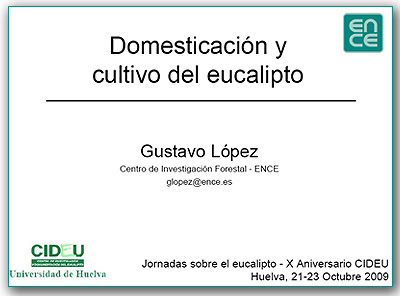
An amazing amount of relevant information on at least these key words: Eucalyptus, forestry, Southern Spain, Northern Spain, quality, industrial uses, soil, water, carbon, history and genetics. Highly recommended!
And our contribution was...

Acknowledgements


Want to contact us?

Contact GIT Forestry Consulting - Eucalyptologics

GIT's Eucalyptology Topics
© 2007-2009 Gustavo Iglesias Trabado. Please contact us if you want to use all or part of this text and photography elsewhere. We like to share, but we do not like rudeness.
Click to Read Full Story...
Click to Display Summary only...
Share
Identifying Mystery Eucalyptus: The case of E. gunnii x nitens hybrids... in Denmark!
Today we bring you some more about eucalypt hybrids. In this case, a type with some interest for those growing the ubiquitous Australian trees in the boundaries of their tolerance to cold. From Denmark, after enduring 8 winters, and thanks to Martin Reimers, we take a peek at Eucalyptus gunnii x nitens ... in two botanical plates!

Fig. 1: Botanical assessment of photographic samples leading to the identification of Martin Reimers' mystery Eucalyptus growing in the Northern shores of the Flensburg Fjord, Denmark, as a hybrid Eucalyptus gunnii x nitens. (Click the image to enlarge, 1280 x 1024 pix)
Product of the viable cross of two relatively closely related eucalypt taxa (both E. gunnii and E. nitens belong to subgenus Symphyomyrtus, Section Maidenaria, and differ just as part of Series Orbiculares and Series Globulares respectively, so they are somewhat "close cousins") , this particular interserial hybrid combination would be very unlikely without human intervention, since each species has its habitat at one side of the Bass Strait. 
Fig. 2: Complementary botanical assessment of E. gunnii x nitens depicting the juvenile organs of both parent species and the hybrid cross. (Click image to enlarge, 1024 x 768 px).
Interestingly, Martin's tree shows some of the well desired effects of heterosis, and of a lucky combination of inherited good form, fast growth and cold hardiness. Precisely, if at some point we hinted that E. globulus x nitens could be of interest for some addition of cold hardiness to a benchmark species for short rotation timber plantations, this time the addition comes "on the other side of the frost spectrum".
Some Interesting Literature...
Listed below, some relevant bibliographic sources for cases like this, which could give the reader some insight on the mechanisms that made hybrid Eucalyptus trees like Martin's possible, and beyond possible, understandable. Reasons enough for compliments to be always sent to the Eucalyptus of France and Tasmania.
Cauvin B, Potts BM & Potts WC (1987). Eucalyptus: Hybridation artificielle - barrieres et hérédité des caracteres. Annales de Recherches Silvicoles 1986, AFOCEL, Paris. pp. 255-303.
Tibbits WN, & Reid JB (1987). Frost resistance in Eucalyptus nitens (Deane & Maiden) Maiden: genetic and seasonal aspects of variation. Australian Forest Research, 17 (1), 29-47 DOI: 0004-914X
Tibbits WN & Reid JB (1987). Frost Resistance in Eucalyptus nitens (Deane & Maiden) Maiden: Physiological Aspects of Hardiness. Australian Journal of Botany, 35 (3), 235-250. DOI: 10.1071/BT9870235
Griffin AR, Burgess IP & Wolf L (1988). Patterns of Natural and Manipulated Hybridisation in the Genus Eucalyptus L'Hérit. A Review. Australian Journal of Botany, 36 (1). DOI: 10.1071/BT9880041
Tibbits WN (1988). Germination and Morphology of Progeny From Controlled Pollinations of Eucalyptus nitens (Deane & Maiden) Maiden. Australian Journal of Botany, 36 (6). DOI: 10.1071/BT9880677
Tibbits WN (1989). Controlled Pollination Studies with Shining Gum (Eucalyptus nitens (Deane & Maiden) Maiden). Forestry, 62 (2), 111-126. DOI: 10.1093/forestry/62.2.111
Tibbits WN, Potts BM & Savva, MH (1991). Inheritance of freezing resistance in interspecific F1 hybrids of Eucalyptus. Theoretical and Applied Genetics, 83 (1). DOI: 10.1007/BF00229235
Bookmark this Interesting Link...

Besides a growing amount of information on the history of Eucalyptus cultivation in Denmark, at www.eukalyptus.dk you can find fine photographic examples of E. gunnii (Cider Gum), E. gunnii x nitens, E. perriniana (Spinning Gum), E. dalrympleana (Mountain White Gum), E. pauciflora ssp. debeuzevillei (Jounama Snow Gum), E. pauciflora (White Sallee), E. nitens (Shining Gum), E. urnigera (Urn Fruited Gum) E. rubida (Candlebark), E. barberi (Barber's Gum), E. coccifera (Tasmanian Snow Gum), E. johnstonii (Tasmanian Yellow Gum), E. subcrenulata (Alpine Yellow Gum) and E. delegatensis (Alpine Ash) including detailed records of their cultivation and behaviour in such an apparently impossible location as the fjords, plains and islands of Denmark.
Also in EUCALYPTOLOGICS... THE EUCALYPTUS OF THE FJORDS


Want to contact us?
Contact GIT Forestry Consulting - Eucalyptologics
GIT's Eucalyptology Topics
© 2007-2009 Gustavo Iglesias Trabado. Please contact us if you want to use all or part of this text and photography elsewhere. We like to share, but we do not like rudeness.
Click to Read Full Story...
Click to Display Summary only...
Share
Selective Harvest of Local Landrace Eucalyptus Seed: The Basics
"Eucalyptus seed quality" is a vast concept. It has many angles. And all of them have an effect on the next generation of trees raised somewhere to be planted somewhere else and later yield an expected amount of timber or non timber products, services and/or externalities. Few times so many big volumes are dependant on such a small weight.

Fig. 1 - Selective local landrace Eucalyptus seed harvest methodology. (Click image to enlarge)
When local landraces develop after the introduction of any Eucalyptus species to a new area of the world, the founder (limited) gene pool (more or less diverse depending on circumstances) starts a cycle of recombination. Many times, human action plays a critical role, either consciously or not, on this long term evolution. Without a minimal conscious effort towards the improvement of the local landraces at the time of seed collection and plant propagation, the results tend to be a decline in productivity after a couple of generations, a by-product of inbreeding.
There are at least two parallel paths to try to counterbalance this tendency. A first one is the introduction of well identified "fresh" genetic material brought from either natural Eucalyptus forests back in Australia or from advanced breeding efforts. Preferrably after testing its superior performance against controls of the local landrace, and preferrably as a part of a broader genetic improvement plan focused on the sequential operational deploy of advanced generations. A second one is trying to refine the local landrace and any subsequent newly introduced gene pool by selective seed harvest. Both paths can be combined.
Many times a parallel breeding program is not feasible due to the too many uncertainties of having as single basement the local landrace. Other times a multiple path combination with breeding efforts based on more newly introduced genetic material is not possible either. But in any case tree breeders, foresters and plant propagators alike should be aware of the importance of applying as simple as possible strategies to contain the advance of inbreeding effects in the local landraces around. Harvest the right seed. Harvest it right!

Fig. 2 - Selectively harvested local landrace candidate plus tree Eucalyptus seed ready for cold storage at GIT Forestry Eucalyptus Seed Bank (Click image to enlarge)
"Individual tree selection yields better results when good even aged tree stands of a convenient age are available. This allows efficient comparison between selected trees and control trees. Individual tree selection yields better results in monospecific even aged natural stands, or in tree plantations. This is, at a large distance from any other, the most common method for first generation tree selection and it has been applied worldwide"
Selectively Harvested Eucalyptus Seed from Northwestern Spain

Basic measures to help improve quality in the Eucalyptus seed trade chain
- Silviculturalist: Ask for details on the seed provenance used to raise the plants you are about to buy to start your Eucalyptus timber growing project. Use this criterium to help you select reputable forestry plant nurseries. Regardless of the level of genetic quality in seed, that information should be part of the archives of any serious forestry plant propagation enterprise.
- Nursery man: Source your Eucalyptus seed from reputable seed sources or specialised merchants, and try to get to know as many details as possible on the parent trees and seed collection methods. Plant propagation is just the last step to the release of genes stored in tree seed. Learn beyond propagation techniques, nursery practice and plant sales. Keep good records of the materials you use. And do not try to save on Eucalyptus seed if saving on seed means great looking seedlings but poor timber crops. Save elsewhere. As someone else well said elsewhere: "Good seed does not cost, it pays".
- Seed merchant: Try to focus also on quality of the product you sell and not only in the margin you obtain from your trade. Tree seed is not lettuce seed. And tree seed in general is not the same as tree seed for timber investment projects.Your actions might have a much longer term impact than for seed of annual crops. Learn about what you sell. Depending on your actions, there can be huge differences for the performance of third party timber investments.
- Seed collector: Try to identify candidate Eucalyptus trees to the plus tree status and collect seed from those and any other according to a minimal of technical criteria, so to help avoid the most obvious risks of poor plant performance. This does not mean you should only collect from plus trees if circumstances force to do otherwise to meet the demand. Bulk seed or individual isolated tree seed collection cannot be avoided sometimes, but keeping eyes well open to see the good trees and being well organised to extract different seed lots according to seed quality criteria, even if from the same seed collection effort, is a good measure.
- Parent tree grower: Keep records of the trees you grow, when did you plant them, where did your seedlings come from, and, if possible, where the original seed came from. Keep a book for your trees.The lineage of your trees matters, as it will affect the performance of their progeny, and the progeny of their progeny both in the case you use that seed as your own stock for propagation and in the case you allow its harvest for release to third parties.
Also at Eucalyptologics...


Want to contact us?
Contact GIT Forestry Consulting - Eucalyptologics
GIT's Eucalyptology Topics
© 2007-2009 Gustavo Iglesias Trabado. Please contact us if you want to use all or part of this text and photography elsewhere. We like to share, but we do not like rudeness.
Click to Read Full Story...
Click to Display Summary only...