Share

"Hundreds of inflorescences, united in umbrellas, panicles or corymbs, thousands of cups toasting to the sky, each one with its foamy sea of stamens to the wind"

"The magic flower of Eucalyptus foams in the breeze. Hundreds of species: big or small trees. Also famous for their flowers"

Enjoy Mazza's new work!


GIT's Eucalyptology Topics
© 2007-2009 Gustavo Iglesias Trabado. Please contact us if you want to use all or part of this text and photography elsewhere. We like to share, but we do not like rudeness.
Click to Read Full Story...
Click to Display Summary only...
Share
Silver-leaved Mountain Gum: blooming cold hardy ornamental Eucalyptus
Eucalyptus pulverulenta have started blooming in Galicia once again! Normal patterns for this specific small-leaved cultivar follow a more usual late autumn blooming period. However, depending on yearly climatic variation and the fertilization regimes, blooming can be delayed after the worst of the winter season is over. Hence, spring bloomers can be achieved!

Fig. 1: General outlook of a blooming E. pulverulenta cultivated in the tablelands of Galicia, Spain (USDA Zone 8b). Click image to enlarge.
Flower bud formation however is always from the previous growth season. This means any "delayed blooming" to next spring relies on the older remaining flower buds. So, the most likely case is a less prolific blooming than the usual happening by autumn, be it because of some of these having already flowered, be it because some of the yet immature buds have disappeared due to the effect of winter gales.

Fig. 2: Detail of flower arrangement on the silver-leaved branchlets of E. pulverulenta. Prolific flowering and gradual blooming can attract huge numbers of pollinators. Click image to enlarge.
No doubt one of the most strange looking ornamental eucalypts able to be grown in Mediterranean and temperate humid conditions, the silver-leaved mountain gum combines a mallee or straggly growth habit with great interest because of the texture and arrangement of its foliage. In addition, prolific flowering adds interest to the plant as a hummingbird or bee attractor, and, of course, as an extra ornamental feature that can be displayed at least twice per year in your garden.
Also in EUCALYPTOLOGICS...
Contact / subscribe to Eucalyptologics
 Contact GIT Forestry Consulting - Eucalyptologics
GIT's Eucalyptology Topics
© 2007-2009 Gustavo Iglesias Trabado. Please contact us if you want to use all or part of this text and photography elsewhere. We like to share, but we do not like rudeness.
Click to Read Full Story...
Click to Display Summary only...
Share

In the grounds of Lullingstone Castle, one of the rarest Eucalyptus species has bloomed for the first time to become the first acclimatized specimen of its kind in the UK.  (Click image to enlarge for a full print)
Back in 1999, while plant hunting in Tasmania, Tom carefully collected a small amount of seed from one of the rarest tree species in the island and one of the least common eucalypts in cultivation around the world, Eucalyptus morrisbyi. And from those seeds, these blooms.
The late "casual" discovery of the species by Robert Brett in 1939 and its scarcity in the wild had prevented it from becoming widely cultivated overseas, as it happens with more common eucalypts. This endangered endemism is nowadays at risk of disappearing in its natural habitat due to poor recruiting of new seedlings, genetic contamination, ocasional drought and browsing. Just some 2000 specimens of Morrisby's Gum are known to survive in wild populations, as its main habitat was cleared for other uses by early settlers many moons before the trees were discovered.
Fortunately, a keen interest from researchers at the School of Plant Science (UTAS) to work out the problems and outline solutions for conservation of this gum tree, plus a proper support from competent administrative bodies in Tasmania mean that E. morrisbyi is currently under the protective umbrella of a recovery plan. May it always be.
For cultivation overseas, like Tom, use respectfully collected seed, or better if sourced from ex situ plantings.
Interesting Literature
- Jones, RC; McKinnon, GE; Wiltshire, RJE; Potts, BM & Vaillancourt, RE (2005) Conservation genetics of an endangered endemic, Eucalyptus morrisbyi. Advances in Plant Conservation Biology, implications for flora management and restoration : symposium program and abstracts 25-27 October 2005 / Dept. of Conservation & Land Management, Botanic Gardens & Parks Authority, Perth, Western Australia, pp. 29.
- Wiltshire, RJE; Potts, BM & Reid, JB (1991) Phenetic affinities, variability and conservation status of a rare Tasmanian endemic, Eucalyptus morrisbyi R.G. Brett. In Banks, MR; Smith, SJ; Orchard, AE & Kantvilas, G. (Eds.) Aspects of Tasmanian Botany – A Tribute to Winifred Curtis. 31(3): 213-229. Royal Society of Tasmania, Hobart.
- Brett, R.G. (1939). The description of a new eucalypt species. Papers and Proceedings of the Royal Society of Tasmania 1938: 129-130
Contact us / Subscribe to Eucalyptologics
GIT's Eucalyptology Topics
© 2007-2008 Gustavo Iglesias Trabado. Please contact us if you want to use all or part of this text and photography elsewhere. We like to share, but we do not like rudeness.
Click to Read Full Story...
Click to Display Summary only...
Share
Swamp Bloodwood eucalypts: pink flowered tropical ornamentals
Notes on phenology and cultivation of Corymbia ptychocarpa (ex Eucalyptus ptychocarpa)
Gustavo Iglesias Trabado 
GIT Forestry Consulting - Consultoría y Servicios de Ingeniería Agroforestal - www.git-forestry.com - EUCALYPTOLOGICS
Fig. 1: Pink flower detail for Corymbia ptychocarpa at Harry P. Leu Gardens. (Image courtesy Eric Schmidt, click to enlarge) Swamp Bloodwoods have started blooming by October at Leu Gardens (Orlando, Florida), our friend Eric Schmidt, resident Botanical Records Specialist, reports. And this type of tree is exactly one of the nice possibilities for the ornamental use of red or pink flowering eucalypts in tropical or subtropical climates.
Fig. 2: Pink blooms in C. ptychocarpa ssp. ptychocarpa at Leu Gardens. (Image courtesy Eric Schmidt, click to enlarge)
With two main subspecies (ssp. ptychocarpa and ssp. aptycha), the natural habitat of this eucalypt is the Northern Coast of Australia, spanning scattered from QLD to WA. Temperatures here are mild day-long and year-long, frost is unheard of, and humidity levels are regularly high all over the year or at least there is a marked rainy season at some point.
Not surprisingly, this bloodwood eucalypt has become popular as a small tree in parks and gardens of the Northern Territory, where it is native and can bloom from February to June.
Fig. 3: Large broad adult leaves of C. ptychocarpa at Leu Gardens. (Image courtesy Eric Schmidt, click to enlarge)
So it is popular overseas. As Ester Foelkel reminds us, C. ptychocarpa is the main pink flowering eucalypt cultivated in alike climates of Brazil. And as we see at Leu Gardens, it can also thrive and bloom in the mildest areas of Florida even in its early years.

It could probably acclimatize well also in not so subtropical climates, with a mediterranean or mild temperate tendence even, as long as absolute minimum temperatures never go below -3ºC (25ºF, equating to USDA Zone 10 or the mildest part of Zone 9) and water supply is abundant, but not excessive. Unlike its close relative species C. ficifolia, it should not be too comfortable in arid conditions. Proper microclimates would increase the chance of survival, and sunny and sheltered spots would increase the chances of early blooming.
Also in EUCALYPTOLOGICS...
Contact us / Subscribe to Eucalyptologics
GIT's Eucalyptology Topics  Subscribe to receive EUCALYPTOLOGICS via RSS
© 2007-2008 Gustavo Iglesias Trabado. Please contact us if you want to use all or part of this text and photography elsewhere. We like to share, but we do not like rudeness.
Click to Read Full Story...
Click to Display Summary only...
Share
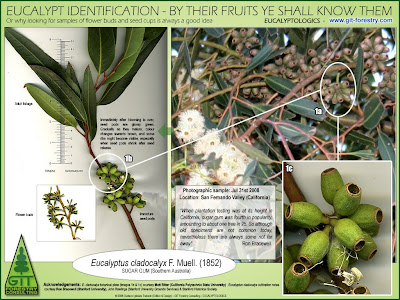
By their fruits ye shall know them (V)
Even more tips on Eucalyptus Identification
Gustavo Iglesias Trabado GIT Forestry Consulting - Consultoría y Servicios de Ingeniería Agroforestal - www.git-forestry.com Fig. 1: Example of leaf comparison assisting flower comparison for accurate Eucalyptus species identification (Click image to enlarge)
Our friend Barrie at Las Palmas Norte-Hardy Palm & Exotics (Lantzville, British Columbia) reported the case of a mystery Eucalyptus in Canada that might require a confirmation of its identification. The main doubt arising was its striking similarity to a Snow Gum (E. pauciflora and allied species and subspecies) for a good number of visual parameters.
Indeed, pictures of the tree in question showed similarities for flower bud clusters, general leaf shape, and not a too dissimilar bark outlook for the case of a young specimen. The most likely candidate within the Snow Gums to match this tree was E. pauciflora ssp. pauciflora, a normally narrow leaved form of the species.
The alternative species suggested by our also eucalyptologist friend Ian Barclay at The Desert Northwest (Sequim, Washington) was E. kybeanensis, the Kybean Mallee Ash. And he might well be totally right.
The plate above provides a comparative view of both species, depicting their similarities for flower buds and bloooms, but also showing how, for this case, observation of leaf shape and size, but more importantly, of leaf venation patterns, can yield an accurate Eucalyptus identification.
In other words: "by their buds and fruits you will know them, but do not forget the other details".
Also in Eucalyptologics...
Click to Read Full Story...
Click to Display Summary only...