








![[Valid Atom 1.0]](http://gus.iglesias.googlepages.com/valid-atom.png "Validate my Atom 1.0 feed")


Rooting Eucalyptus cuttings... by millions... everyday!
Gustavo Iglesias Trabado 
GIT Forestry Consulting SL - Consultoría y Servicios de Ingeniería Agroforestal - www.git-forestry.com - EUCALYPTOLOGICS
GIT Forestry Consulting SL - Consultoría y Servicios de Ingeniería Agroforestal - www.git-forestry.com - EUCALYPTOLOGICS
Every now and then we are contacted at Eucalyptologics with inquiries about Eucalyptus being able or not to be propagated by cuttings, even after the Woodpeckers of Paraná have already proved in this same weblog it is very possible. So, being in Brazil already, it would have been a major nonsense not to visit the largest Eucalyptus pulp maker in the world and bring you back direct proof it is more than possible!

Fig. 1: Clonal gene bank. Multiple copies of several select genotypes are kept as pruned Mini-Hedges and used as mother plants. From these, cuttings are harvested regularly to multiply vegetatively the fastest growing high yielding strains of the hybrid Eucalyptus urophylla x grandis.
When you manage an industrial forestry resource the way the Brazilian pulp and paper industry does, the motto is always "bigger, better, faster". And that starts from the very beginning! It means that each cultivated hectare should yield as much product as possible in as little time as possible at the lowest cost as possible without losing quality and under the principles of sustainable forestry.
Genetic improvement is a must for that. Tree breeding a need. It does not cost money, it saves money! After selecting the best performing specimens from wild or controlled crosses, what forest geneticists want is a whole estate filled with a new generation of supertrees. And the fastest way to deploy genetic gain is no other than mass propagation of select strains: Eucalyptus clonal forestry.

Fig. 2: Detail of the clonal Eucalyptus Mini-Hedge. Eucalyptus resurrection happens from dormant buds after each cutting harvest, providing new future cuttings, and hence new ramets.
All in all, nothing different from what you do at home when propagating fig trees, bananas, agaves or a thousand other different plants whose fruits we use or whose looks we enjoy everyday. Except that for this process to be cost-effective in the case of Eucalyptus propagation, you need some extra ingredients...
First of all, you need something reasonable to propagate! You do not invest a truckload of money setting up the minimum infrastructure necessary for mass vegetative propagation without thinking first what trait you want to improve in your Eucalyptus trees. So, a lengthy process of testing and selection for the desired trait or traits must be done in advance. After that, you also need to consider that for cost-efficient mass propagation, you need genotypes with a high rooting ability for the rooting method you are going to apply. This means a more strict selection over candidate select strains, and ongoing tests to refine both selection and propagation methodologies!
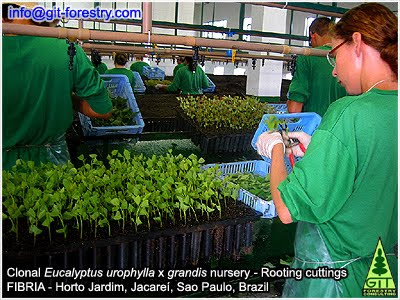
Fig. 3: Cutting selection and transplanting area. Select strains with high rooting ability harvested from the clonal bank are propagated by inducing root formation. Skilled labour and good control of temperature and humidity are necessary.
But having done all that, you yet need the proper minimum conditions to enhance root formation: high humidity, hygiene, nice temperature, a proper substrate, and a number of different environments to gradually move the rooted cuttings to their final destination.
Skilled labour is necessary at all stages: you need people with experience to harvest the Eucalyptus cuttings at the right time and with the right size; you need people with experience to select and prepare the Eucalyptus cuttings for rooting, and you need people with experience to prepare, handle and take care of the trays of Eucalyptus ramets along the whole production cycle.

Fig. 4: After a time at specially designed greenhouses, once roots have formed, the select Eucalyptus ramets are moved outdoors, to be grown to final planting size and to harden.
If all this is done properly, and if all the right ingredients are wisely used, then a Eucalyptus clonal nursery works as a Swiss clock, and is able to provide the right planting stock of supertrees as to replace an older generation of Eucalyptus timber crops by a faster growing higher yielding lower cost generation.
That is how you can increase the productivity of a given estate for the desired end product without necessarily increasing your cultivation area, which is a more costly alternative beyond a financial threshold. Which in turn can allow you to obtain faster growing renewable and recyclable fiber or biomass timber crops each year at once you manage your estate for simultaneous preservation of native ecosystems, hence avoiding some of the most evident environmental impacts of large monocultures.

Fig. 5: Only 7 years after planting, a whole new crop of Eucalyptus urograndis timber is ready for harvest, and as resurrection from coppice takes place without human intervention, a new cycle of timber production starts again almost by magic. (Click image to enlarge and see yours truly puzzled at growth rates).
In the end, growing trees, native or exotic, for an industrial purpose, if done joining at once the right technologies based on the study of tree biology and genetics and enough sensitivity to manage the man-made primary resource according to a minimum of consideration for the non productive pieces of the ecosystem... ends up relieving some pressure from other areas of the ecosystem. Always necessary while we try to keep up with the never-ending race to supply an always increasing world population with the basic raw materials that, we want it or not, will keep being demanded.
From these high tech cultivated Eucalyptus forests, the product (wood fibers) is transported to the nearby factory, where, under a thousand of different forms, it ends up becoming something you and I use everyday and some take for granted as a normal commodity.

Fig. 6: A sustainable timber production pattern that allows a proper feeding menu for the first single digestor in the world able to reach a production of 1,000,000 ton Eucalyptus cellulosic pulp (back in 2005!): FIBRIA's Jacareí Pulp & Paper Mill.
Only a few decades ago, before the cultivation of trees as Eucalyptus was generalized, paper was an expensive luxury, costly to produce both from a financial and an environmental perspective. Today, even with the normal concerns for an increased respect to the surroundings that every industrial activity should keep, the Eucalyptus pulp and paper industry of Brazil, based on the domestication of these Australian trees and the learning process initiated in this same Sao Paulo we have showed you by Edmundo Navarro de Andrade 100 years ago, walks steadily towards sustainability.
The work is not done however. It is being done every day. Since you started reading this article some minutes ago, some number between 10,000 and 15,000 eucalypts have been planted in Brazil alone to start producing the fibers you will use less than a decade ahead without even noticing. The same is happening all around the world as you read this: in Chile, Uruguay, South Africa, Spain, Portugal, India, China, Australia... And it all starts in a rooted Eucalyptus cutting.
Acknowledgements


Want to contact us?

Contact GIT Forestry Consulting - Eucalyptologics

GIT's Eucalyptology Topics
© 2007-2009 Gustavo Iglesias Trabado. Please contact us if you want to use all or part of this text and photography elsewhere. We like to share, but we do not like rudeness.


