Share
Chasing... the Tallest Trees in Europe

So what if you received an unexpected call asking you to join a Giant Tree Trek visiting what probably are the tallest trees in Europe... and you said "Yes, Sir (of course!!!)"?
What if as a result of such an adventure you had gathered several hundred measurement data & biological samples, several hundred photographs documenting the whole expedition, and several dozen minutes of video footage depicting such unique Eucalyptus Tree Giants?

The only possible reasonable answer to those three question is... you do it... you enjoy it... and you tell the story!
So... What about joining us & the friends making this all possible in a virtual trek to the "Nova Australia" of Spain & Portugal while chasing Eucalypt Giants with Dean Nicolle? If your answer is also "Yes, Sir", the only thing you have to do is fastening your seatbelts, and staying tuned... to Eucalyptologics! And who is that guy?
Dr. Dean Nicolle, "El Cazador de Eucaliptos", has discovered or co-discovered +50 new eucalypt taxa in Australia, helping the known eucalypt biodiversity threshold surpass 1000 taxa. He is the Director of Currency Creek Eucalypt Research Arboretum, the most complete eucalypt collection and genetic repository in the world, with +90% of those taxa represented and cultivated for scientific purposes. He has collected and preserved +5000 eucalypt genetic lines, many of them endangered species or subspecies, some facing extinction risks. He is author or co-author of +50 scientific articles on eucalypt botany, and his work has made +40 extra articles by several international scientific research groups possible. Arborist and ecologist, his remarkable eucalypt tree inventory surpasses +9000 specimens, and from it, +4000 technical reports on remarkable eucalypts have been produced, including +150 new additions to the Australian Giant Tree National Register.
Also at EUCALYPTOLOGICS...


More Eucalyptus Giants around this site
Contact us / Subscribe to Eucalyptologics
 Contact GIT Forestry Consulting - Eucalyptologics
 GIT's Eucalyptology Topics
 Subscribe to receive EUCALYPTOLOGICS via RSS
Click to Read Full Story...
Click to Display Summary only...
Share
Storm Xynthia's Legacy: Over 4 million cubic metres Stormwood in the European Union
From February 27th to 28th 2010 the 228 km/h strong wind and rainstorm Xynthia hit Western Europe in a fast trip Northwards along the Atlantic coast, causing 65 fatalities and widespread material damage. As the first week after the event passed, it unveiled also a grim outlook for European forests from Galicia in Northwest Spain to the Baltic Sea, as stormwood accumulates near the hurricane pathway in Spain, France & Germany. 
A first overall estimation of stormwood volumes exceeds 4 million cubic metres of timber scattered over European forest soils, mainly in Germany (more than 80% total). Affected areas following the path of the hurricane are Galicia (0.10 million m3) & the Basque Country (0.15 million m3) in Spain; the Pyrènèes Maritimes (0.10 million m3), L'Allier (0.01 million m3), the Meuse (0.05 million m3) & the Vosges (0.10 million m3) in France; the Ardennes (little damage) in Belgium; and Saarland (0.1 million m3), Rhineland-Palatinate (1.7 million m3), Hessen (1.2 million m3), Westfalia (0.4 million m3), Thuringia (0.1 million m3), the Harz Forest (0.07 million m3) & Northern Bavaria (0.02 million m3) in Germany.
The most affected region according to estimated stormwood volumes seems to be the Rheineland-Pflaz in Germany, so its forestry shrine, the Palatinate Forest, may be considered "Ground Zero" for Event Xynthia. Acknowledgements
Asociación Galega Monte-Industria (SPA), Bayerische Staatsforsten AöR (GER), Confederación de Forestalistas del País Vasco (SPA), Consellería do Medio Rural - Xunta de Galicia (SPA); IES - Institute for Environment and Sustainability - European Commission Joint Research Centre (ITA) , Fédération Nationale des Syndicats de Forestiers Privés de France (FRA), Landesbetrieb Hessen-Forst (GER), Landesbetrieb Wald und Holz Nordrhein-Westfalen (GER), Landesforsten Rheineland-Pfalz (GER), Thüringer Ministerium für Landwirtschaft, Forsten, Umwelt und Naturschutz (GER), MeteoFrance - Ministère de l'Ecologie, de l'Energie, du Développement Durable et de la Mer (FRA), MeteoGalicia - Consellería de Medio Ambiente, Territorio e Infraestruturas - Xunta de Galicia (SPA); Niedersächsische Landesforsten (GER), Office National des Forêts (FRA), SaarForst Landesbetrieb (GER) & others.
Also at EUCALYPTOLOGICS...


Contact / subscribe to Eucalyptologics
Contact GIT Forestry Consulting - Eucalyptologics
GIT's Eucalyptology Topics
© 2007-2010 Gustavo Iglesias Trabado. Please contact us if you want to use all or part of this text and photography elsewhere. We like to share, but we do not like rudeness.
Click to Read Full Story...
Click to Display Summary only...
Share
Eucalyptus in the Fridge (2008-2009)
Or predictions for frost damage impact on cold hardy Eucalyptus in Northwestern Spain, based on yearly observation of patterns of climate and tree growth
Gustavo Iglesias Trabado 
Year 2008 left with frown ups for cold hardy Eucalyptus growers in the Northern Hemisphere. For Eastern USA growers (South Carolina to New York), November brought heavy early freezing causing considerable damage but also species trials being culled by Captain Winter. December was also critical for growers in Northwestern USA (Oregon & Washington) and in Canada (British Columbia & Vancouver Island) due to heavy snowfalls and week-long frost & ice storms at sea level, putting to test ornamental plantings in many gardens. But 2009 has started also quite wintery for frost tolerant eucalypt growers in Central and Northern Europe, since they received the visit of Siberian cold blasts brought by Eastern winds during early January, with absolute minima plummeting to levels unheard of since mid 1980's (-20ºC in Germany, -18ºC in the Netherlands & Belgium, -15ºC in France). 
Fig. 1 - Prediction of frost & ice damage to cold hardy Eucalyptus nitens following December 2008 Frosty Week in the highlands of Galicia (Click image to enlarge)
For Northwestern Spain, things have been relatively mild by late 2008. Excepting the worst snowfall in 15 years covering the highest hills, our cold hardy Eucalyptus in Galicia have not endured the effects of the Siberian cold wave of January 2009. However they have suffered one year more the effects of an almost classical "Christmas Frosty Week".
Seven consecutive frost & ice events put the eucalypt plantations of inland Galicia (mainly Eucalyptus nitens cultivated forests at 500-800 meter elevation) to yet another good cold hardiness test, especially when grown at frost pockets, as in the pictured case. After years of observation of weather patterns during the worst of winter and its impact on over two dozen of Eucalyptus species on trial, there it goes our prediction (Fig. 1) for frost damage impact after the December 2008 events.
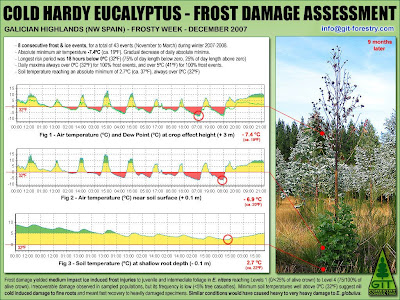
Fig. 2 - 2008 assessment of frost & ice damage to Eucalyptus nitens following December 2007 Frosty Week in the highlands of Galicia (Click image to enlarge)
As a reminder, this "Frosty Week" was milder than the previous one in December 2007 (Fig. 2). That winter, more near the climatic average for our USDA Hardiness Zone 8b, brought interesting results on cold hardiness for several of the Index Species (E. globulus for EUCF Zone, E. nitens for ATL1 Zone and E. gunnii for ATL2 Zone) in our conditions, and also interesting results for other eucalypt species to compare to each of the index species due to their theoretical similarity in tolerance to frost.
Suggestion of Key Climatic Parameters to Assess Eucalyptus Cold Hardiness
Absolute minimum air temperature (minima minimorum) during the most restrictive event of a given winter: Allows to refine the "non plus ultra" temperatures for successful cultivation of a given species.
Tendency of daily minimum air temperatures for the longest span of consecutive frost events, or previous and following days to one-night singular frost events: Allows a look at a broader range of events and their potential interaction. As example, you can compare to the dew point to work out when the frost point is reached, so when your eucalypts go from the fridge to the freezer.
Longest time span under zero (0ºC / 32ºF): Allows the identification of frosting and defrosting patterns, or trees going in and out of the freezer, even if just some hours per day. And helps to work out what is the "non plus ultra" time in the freezer for your eucalypts.
Tendency of daily maximum air temperatures for the longest span of consecutive frost events, or previous and following days to one-night singular frost events: Allows the identification of radiational frost events and changes in temperature gradients along tree height, which can be dependant on insolation. If available for several heights adapted to crop height, then you kick ass.
Tendency of soil temperatures for the longest span of consecutive frost events, or previous and following days to one-night singular frost events. Allows to track the extent of "near-permafrost", if any, and its damage to root systems (which affects Eucalyptus resurrection!).
Keeping track of all this is not that easy, as you surely need some hi tech weather measuring equipment. But not all of this is necessary everywhere. However a sound base weather station to which correlate field measurements or data collected from temporary outlier weather sensors can save you some headaches. For amenity growers, absolute minima and maximum lenght of under zero periods are the minimum quantitative information to try to track and keep records of!
You can't grow Eucalyptus there...
Because it snows. Or because winters are frosty. So yes. Don't try. It is impossible.

(Click image to enlarge)
Also at EUCALYPTOLOGICS...
Contact GIT Forestry Consulting - Eucalyptologics
GIT's Eucalyptology Topics Subscribe to receive EUCALYPTOLOGICS via RSS
Click to Read Full Story...
Click to Display Summary only...








![[Valid Atom 1.0]](http://gus.iglesias.googlepages.com/valid-atom.png "Validate my Atom 1.0 feed")

 Subscribe to receive EUCALYPTOLOGICS via e-mail