

Quickribbon
Showing posts with label alelopathy. Show all posts

Eucalyptus in India: timber and wheat polyculture

Share

Gustavo Iglesias Trabado Contact GIT Forestry Consulting
GIT Forestry Consulting - Consultoría y Servicios de Ingeniería Agroforestal - www.git-forestry.com - EUCALYPTOLOGICS


A combined plantation of Eucalyptus and wheat? Combining Eucalyptus and pasture? Planting at once Eucalyptus and green manure crops? Noooo. Are you nuts? That's impossible. Everyone knows the "Environmentalist Theorem nº 835/a" states that Eucalyptus are those evil alien invasive tree species poisonous to your soil, and where you plant one, nothing can grow again.

Luckily for our hungry world, reality is almost always very different to environmentalist mythology.


Eucalyptus Polyculture in India: timber and grain

Pragati Biotech clonal Eucalyptus polyculture as agroforestry system in India / Policultivo de clones de Eucalyptus en sistema agroforestal, Pragati Biotech, India / Eucalyptologics, on Sustainable Eucalyptus cultivation / Gustavo Iglesias Trabado, GIT Forestry Consulting, Consultoría y Servicios de Ingeniería Agroforestal, Galicia, Spain, España / Eucalyptologics: Recursos de Informacion sobre Cultivo Sostenible del Eucalipto en el Mundo

One out of many good examples of this are the eucalypt and poplar trees of Mr. Piare Lal in Andhra Pradesh and the Punjab. After nearly 40 years of experience in applied forestry science, the grounds of Pragati Biotechnologies (www.eucalyptusclones.com) are today a landmark for high-tech forestry, located not too far away from where the pioneers of the Green Revolution developed 'Kalyan', the first high yielding wheat of India.


But these versatile trees able to yield multiple products and services are not simply raised there for delivery to Indian farmers. Operational fields trials allow visitors to also see the combined outcomes of both tree breeding and intelligent agro-forestry design.

Eucalypt cultivated forests can achieve this way a new dimension: joining agricultural and forestry productions within the same pieces of land. Annual crops of yearly benefit while timber matures.
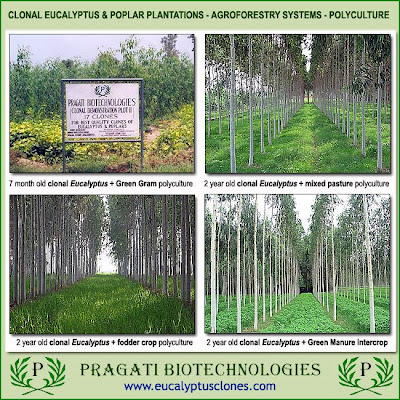
Pragati Biotechnologies clonal Eucalyptus polyculture as agroforestry system in India / Policultivo de clones de Eucalyptus en sistema agroforestal, Pragati Biotech, India / Eucalyptologics, on Sustainable Eucalyptus cultivation / Gustavo Iglesias Trabado, GIT Forestry Consulting, Consultoría y Servicios de Ingeniería Agroforestal, Galicia, Spain, España / Eucalyptologics: Recursos de Informacion sobre Cultivo Sostenible del Eucalipto en el Mundo
(Click image to enlarge)

Over 150 different select Eucalyptus clones, of both first generation pure and advanced generation E. tereticornis x camaldulensis hybrids, are being made available by Pragati Biotechnologies to tree investors in Punjab, Haryana & Uttar Pradesh wanting to take advantage of the genetic gains delivered by eucalypt tree domestication and breeding. Doubling or treebling the MAI achieved with standard tree nusery stock and making it compatible with other crops is no joke for a country with ever increasing needs of both food and raw timber. It is however a task for Norman Borlaug styled characters. Of Piare Lal type.


Corollary...

At Eucalyptologics we hope that, next time you hear or read one of the many misguided "environmental activist" trying to spread analphabetism on the subjects of monoculture, invasive alien species or Eucalyptus poisoning soils instead of trying helping fix the real problems out there, you remember cases as the one depicted today. You can then compare and decide for yourself what's going on with all that green mythology spreading like a noxious weed. Luckily, sooner or later, myths fall by their own weight. Or sometimes, with your extra help.


Also at EUCALYPTOLOGICS...


Contact us / Subscribe to Eucalyptologics


EUCALYPTOLOGICS: GIT Forestry Consulting Eucalyptus Blog / Information Resources on Eucalyptus Cultivation Worldwide / Forestry Engineering, Eucalyptus Seed, Eucalyptus Plants, Eucalyptus Wood, Eucalyptus Honey, Eucalyptus Essential Oil, Eucalyptus Forests, Eucalyptus Plantations, Eucalyptus Timber, Eucalyptus Lumber, Eucalyptus Furniture, Eucalyptus Veneer, Eucalyptus Plywood, Eucalyptus MDF Board, Eucalyptus Cellulose, Eucalyptus Paper, Eucalyptus Biomass, Eucalyptus Energy, Eucalyptus Floristry, Eucalyptus Foliage, Eucalyptus Garden / Ingenieria Forestal, Semilla de eucalipto, Plantas de eucalipto, Madera de eucalipto, Miel de eucalipto, Aceite Esencial de eucalipto, Bosque de eucalipto, Plantacion de eucalipto, Muebles de eucalipto, Tablero de eucalipto, MDF de eucalipto, Celulosa de eucalipto, Papel de eucalipto, Biomasa de eucalipto, Energia de eucalipto, Ramillo Verde Ornamental de Eucalipto, Jardin de EucaliptoGIT's Eucalyptology Topics

© 2007-2008 Gustavo Iglesias Trabado. Please contact us if you want to use all or part of this text and photography elsewhere. We like to share, but we do not like rudeness.

Click to Read Full Story...

6 myths about Eucalyptus: environmentalists lie

Share

Eucalyptus: Myth and Truth

by Rubens Garlipp (*)


(*) Forestry Engineer Rubens Garlipp is the Director of the Brazilian Society of Silviculture (SBS)

SOCIEDADE BRASILEIRA DE SILVICULTURA

www.sbs.org.br


Six Myths promoting your environmental analphabetism about Eucalyptus

by Xusto de Andrade (**)

We bring you today a commented visual summary of six key ideas often arising within environmental activist speeches and literature related to Eucalyptus. All of these are just a small sample of obsolete dialectic tools unsuccessfully used by environmentalist authors during the last 35 years against Eucalyptus forestry.

The general process for the intentional creation of these myths that promote your analphabetism about Eucalyptus normally involves choosing a tiny and non representative fragment of truth or opinion generated somewhere, no matter its degree of credibility, then exaggerating it, then overgeneralizing it, and finally oversimplifying it before delivering it to you and me through a variety of media.

The last step is in many cases convincing some innocent journalist to publish it somewhere. Or paying with the money raised by your and my donations "for a better environment" to get it published somewhere. Many times it ends up printed on high quality papers produced from virgin or recycled cellulosic fibres sourced from sustainably managed Eucalyptus plantations in five continents. Ironic, isn't it?

If you are well inclined to read authors relying on science, be it forestry, biology, ecology or environmental science, you start moving towards a safer position preventing you from falling into induced environmental analphabetism. If you read environmentalist activism propaganda without trying to balance such information with others, you are at risk.

So, we give you now, aided by Rubens Garlipp, a first set of visual information pieces based on science so you can choose to compare them to each of these six myths about Eucalyptus often used by environmentalist authors to promote environmental analphabetism. This way you might be able to work out more easily in future which environmental activists are trying to pollute your mind with half truths, demagoguery and plain lies, and which are not.

The Analphabet Environmentalist: Eucalyptus Myth nº 1

"Eucalyptus plantations are evil because they are not native tree species"

Environmentalist pollution: Promoting ignorance on +3,000 years of human driven introduction and use of exotic biologic species in five continents for horticultural production, agricultural production, animal production and industrial raw material sourcing. You eat, drink, wear and use exotic species every day. And environmentalists too.

The Analphabet Environmentalist: Eucalyptus Myth nº 2

"Eucalyptus plantations are evil because they dry up soils"

Environmentalist pollution: Promoting ignorance on water cycles, water use and water use efficiency within and outside of Eucalyptus cultivated forests. You eat, drink, wear and use organic materials produced by less efficient organisms every day. And environmentalists too.

The Analphabet Environmentalist: Eucalyptus Myth nº 3

"Eucalyptus plantations are evil because they cannot co-exist with agriculture"

Environmentalist pollution: Promoting ignorance on agroforestry, mixed productions and compatibility of land uses involving Eucalyptus cultivated forests. You eat, drink, wear and use products from co-existant agricultural and forestry land uses every day. And environmentalists too.

The Analphabet Environmentalist: Eucalyptus Myth nº 4

"Eucalyptus plantations are evil because they deplete soils"

Environmentalist pollution: Promoting ignorance on soil nutrient cycles, nutrient recycling and nutrient use efficiency, especially for Eucalyptus planted forests. You eat, drink, wear and use materials produced from less efficient nutrient user organisms every day. And environmentalists too.

The Analphabet Environmentalist: Eucalyptus Myth nº 5

"Eucalyptus plantations are evil because they are only useful for pulp production"

Environmentalist pollution: Promoting ignorance on +50 different products, services and positive externalities generated directly or indirectly by Eucalyptus plantations in five continents. You breathe, eat, drink, wear and use them every day without even noticing. And environmentalists too.

The Analphabet Environmentalist: Eucalyptus Myth nº 6

"Eucalyptus plantations are evil because they create green deserts"

Environmentalist pollution: Promoting ignorance on environmental impacts, landscape architecture, biodiversity and ecology of forest ecosystems for which Eucalyptus are one piece of the puzzle. You cannot properly assess the interactions if not being a competent scientific ecologist able to see the other key pieces of the puzzle. And environmentalists neither.

So, now you are provided with information from both opposite angles (thesis and antithesis), you are free to use your own common sense to ponder, and decide freely what your personal conclusions are. It is called synthesis.


Recommended information resource

Eucalyptus: Myth and Truth 

by Rubens Garlipp

Seminario Florestas Plantadas do Mato Grosso do Sul.

PowerPoint presentation: 52 slides (Portuguese)

DOWNLOAD (PDF, 19 MB)


Remember

El que contamina, paga

nº Environmentalist authors identified: 218

nº Environmentalist pollutant emissions identified: 4,163

% Environmentalist pollutant emissions assigned to author or NGO: 81%


(**) Xusto de Andrade es silvicultor, economistólogo, sabe mover leña, y poner el dedo en la llaga... verde.


Also in Eucalyptologics ...


Berserker Koalas, Issue 0, We Shall Defend our Islands. Environmentalist fraud exposed by Koala Army, by Xusto de Andrade / A comedy fanzine brought to you by EUCALYPTOLOGICS, Information resources on Eucalyptus cultivation worldwide / Los Koalas Cabreados, Numero 0, Defenderemos nuestras islas. El fraude ecologista descubierto por el ejercito koala, por Xusto de Andrade / Una comedia grafica difundida por EUCALYPTOLOGICS
Environmentalist fraud exposed by koala army


EUCALYPTOLOGICS has just unexpectedly received the impressive document on Sustainable Forestry Management topics displayed above. As neutral observers we are not too keen to put into the air every piece of information we get from varied sources, especially if falling into polemics. But as firm believers in freedom of speech, we are not going to apply censorship to these opinions even if we do not fully endorse them. Not when they are loaded of this fine sense of humour!

Disclaimer: The views and opinions expressed in the transcription above are not necessarily those of EUCALYPTOLOGICS and we decline any responsibility on their potential effects for third parties.

EUCALYPTOLOGICS: GIT Forestry Consulting Eucalyptus Blog / Information Resources on Eucalyptus Cultivation Worldwide / Forestry Engineering, Eucalyptus Seed, Eucalyptus Plants, Eucalyptus Wood, Eucalyptus Honey, Eucalyptus Essential Oil, Eucalyptus Forests, Eucalyptus Plantations, Eucalyptus Timber, Eucalyptus Lumber, Eucalyptus Furniture, Eucalyptus Veneer, Eucalyptus Plywood, Eucalyptus MDF Board, Eucalyptus Cellulose, Eucalyptus Paper, Eucalyptus Biomass, Eucalyptus Energy, Eucalyptus Floristry, Eucalyptus Foliage, Eucalyptus Garden / Ingenieria Forestal, Semilla de eucalipto, Plantas de eucalipto, Madera de eucalipto, Miel de eucalipto, Aceite Esencial de eucalipto, Bosque de eucalipto, Plantacion de eucalipto, Muebles de eucalipto, Tablero de eucalipto, MDF de eucalipto, Celulosa de eucalipto, Papel de eucalipto, Biomasa de eucalipto, Energia de eucalipto, Ramillo Verde Ornamental de Eucalipto, Jardin de EucaliptoGIT's Eucalyptology Topics

Subscribe to receive EUCALYPTOLOGICS via RSS


© 2008 Gustavo Iglesias Trabado. Please contact us if you want to use all or part of this text and photography elsewhere. We like to share, but we do not like rudeness.

Click to Read Full Story...

Eucalyptus poisoning soil? (I)

Share

Seven key issues on Eucalyptus and alelopathy
Or seven reasons why stating eucalypts poison soils is mostly... bullshit

Gustavo Iglesias Trabado Contact GIT Forestry Consulting
GIT Forestry Consulting - Consultoría y Servicios de Ingeniería Agroforestal - www.git-forestry.com - EUCALYPTOLOGICS


We frequently receive inquiries at EUCALYPTOLOGICS from concerned gardeners, horticulturalists and even
Eucalyptus timber plantation owners in regard to the widespread notion of these trees "being poisonous to the soil" and "dangerous for understorey flora". Today we hope to help throw some light over this myth.


Giant Eucalyptus camaldulensis and understorey at Inca Botanical Garden, Malaga, Spain, by Dan Anderson, Exploring the World of Trees, a Tree Species Blog / Eucalipto rojo gigante y sotobosque en el Jardin Botanico Inca de Malaga, España, por Dan Anderson, Tree Species / Gustavo Iglesias Trabado / GIT Forestry Consulting, Consultoría y Servicios de Ingeniería Agroforestal, Lugo, Galicia, España, Spain / Eucalyptologics: Information Resources on Eucalyptus Cultivation Worldwide / Eucaliptologics: Recursos de Informacion sobre el Cultivo del Eucalipto en el MundoFig. 1: Healthy understorey plants growing under an Eucalyptus tree. Image courtesy Dan Anderson, www.tree-species.com (Click image to enlarge)

We picked this example to ellaborate on this particularly interesting topic due to the excellent conditions of this tree as evidence of myth being myth. Approaching one hundred years old, the giant E. camaldulensis at Inca Botanical Gardens has had enough time to deplete and poison the soil around it. Doom predictions would say nothing could be growing near it for more than 50 years. Then why a healthy understorey of bromeliads, palms and lush subtropical plants is thriving under this evil Eucalyptus?

Giant Eucalyptus camaldulensis and understorey at Inca Botanical Garden, Malaga, Spain, by Dan Anderson, Exploring the World of Trees, a Tree Species Blog / Eucalipto rojo gigante y sotobosque en el Jardin Botanico Inca de Malaga, España, por Dan Anderson, Tree Species / Gustavo Iglesias Trabado / GIT Forestry Consulting, Consultoría y Servicios de Ingeniería Agroforestal, Lugo, Galicia, España, Spain / Eucalyptologics: Information Resources on Eucalyptus Cultivation Worldwide / Eucaliptologics: Recursos de Informacion sobre el Cultivo del Eucalipto en el MundoFig. 2: Monumental Eucalyptus camaldulensis growing among palms in the Inca Botanical Garden of Malaga, Spain. Image courtesy Dan Anderson, www.tree-species.com (Click image to enlarge)


The answer could not be more simple:
because a plant causing alelopathic effects on its surrounding habitat is not equivalent to a plant keeping infinite arsenals for chemical warfare that affect everything around it.


SEVEN KEY QUESTIONS ON EUCALYPTUS POISIONING SOILS


Question 1: What is alelopathy?


Alelopathy defines a natural type of interaction between different plants, in which one of them has adapted to release to a defined space around it an amount of natural organic chemical compounds during their normal biologic cycle. These alelo-chemicals can, in certain circumstances, add to other natural competitive advantages result of evolutive adaptation to favour the survival, establishment or reproductive maturity of a certain plant against another in a defined space where resources (light, water, nutrients) are limited.


Question 2: Are
Eucalyptus alelopathic plants?

Yes, since Eucalyptus are plants and all plants are alelopathic to some extent, as they all release organic chemical compounds when their discarded biomass degrades, and these natural organic chemical compounds leach on to the soil, where they interact with other elements of local biota.


Question 3: Does alelopathy in
Eucalyptus have something to do with they being exotic species?

No. In Australia, where they are native, they also cause alelopathic impacts on surrounding flora. And in any habitat you can find native plants causing the same sort of impacts on surrounding biota in varying degrees. Alelopathic and exotic are two independent concepts, and linking both as the two parts of a cause-effect relationship shows deep ignorance on basic biological and ecological processes. Pay attention when you see both terms in the same sentence, statement or argument in a discussion, as it normally will give you hints on the speaker.


Question 4: How do
Eucalyptus alelopathic effects impact other plants?

Following the same pattern than any other plant causing alelopathic effects: in several ways, but very rarely as a single factor.

The combined action of at least...
  • Natural events to which many Eucalyptus species have adapted their reproductive processes (e.g. fire) while other plants have not, making less desirable habitat for non adapted to some plants while favouring others
  • Fast development of root systems compared to some plants, which can give them quicker access to soil moisture and making less desirable habitat for water demanding plants there while favouring others
  • Quick canopy development and litter formation, meaning quick shading of understorey and making less desirable habitat for full sun plants there while favouring others
  • And the release of natural organic alelo-chemical compounds to the soil, which can inhibit germination of certain plant seeds while favouring others or contribute directly or indirectly to the slower growth of some plants while favouring others
... can cause impacts on any other element of the biota around Eucalyptus. Each of the other plants thrives between thresholds for any given natural factor affecting survival and growth. Probably many other factors could also be included, but those four are enough to illustrate the complex relationships of biota and environment.

For the case of alelo-chemical compounds considered as a single factor in this equation, each different plant taxon will behave differently, some totally tolerating the available amount of alelo-chemicals perfectly, some being affected to a certain degree, and some being non tolerant. It is a dynamic process, and it activates further adaptative processes in all the other plants. Those unaffected will keep growing and reproducing, those non critically affected will evolve towards tolerance given enough genetic variability so some will keep on growing and reproducing, and those non tolerant will be replaced in their ecologic niche by other organisms that will keep growing and reproducing. Evolution under our noses.

A dynamic ecosystem in continuous adaptation. But not anihilation, sterilisation or desertification. Again,
pay attention when you any of these or similar terms together in the same sentence, statement or argument in a discussion, as it normally will give you hints on the speaker.


Question 5: Can we safely grow other plants under Eucalyptus in our gardens?

Yes, but results will largely depend on... what your garden is like, what your Eucalyptus are like, what plants you are planting under them and how you manage this small ecosystem. Each plant will have a maximum and minimum treshold for each main restriction to survival and growth, be it water availability and use, tolerance to shade, abundance of nutrients or tolerance to any of the organic compounds present in soil and being released by the Eucalyptus and any other plant nearby. Or any other factor having influence in the final outcome.

Each of your gardens will become a real laboratory and you will have the opportunity to observe what is going on and realize that you cannot blame alelopathy for your other plants dying if you have not watered them during that severe summer drought.


Question 6: What about cultivated forests based on Eucalyptus as main timber species?

This question alone could yield a very long argumentation. It is more suitable as a separate ellaboration, since multiple concepts need to be introduced during its discussion, many of them related to environmental impact assessment, landscape scale considerations, management regimes, and the dynamics in space and time of this more complex than a garden but yet simplified ecosystem any cultivated forest is, irrespectively of the tree species in consideration and its character of native or not to a particular ecosystem.

But, to not let you go with empty pockets, enough mentioning quickly that, the same way you can grow garden plants in the understorey of an eucalypt, many possibilities arise for a wider scale policulture (simultaneous cultivation on the same soil) involving Eucalyptus as tree cover. There are countless examples of these agroforestry systems in all five continents, from relatively simple ones involving pasture or natural grazelands plus Eucalyptus trees (silvopasture) to relatively complex serial crops (multicrop) as sugarcane plus Eucalyptus; maize plus Eucalyptus; pineapple plus Eucalyptus; coffee plus Eucalyptus; Leucaena plus Eucalyptus; cotton plus Eucalyptus; rice, beans and Eucalyptus... as many combinations as adventurous agronomists.

As you can imagine, if the myth of Eucalyptus sterilising soils or making it unusable for every other plant sustained itself, none of these would be possible. But they are. Yet once again, pay attention when you see any of these or similar terms together in the same sentence, statement or argument in a discussion, as it normally will give you hints on the speaker.


Question 7: Why is the myth of
Eucalyptus poisoning soils so popular then?

Ahh... now that is a good question, isn't it? It has also many answers, but let's keep it simple.

Because the average urbanite Western citizen is deeply ignorant on agriculture, forestry, the dynamics of ecosystems or long term evolution of landscape parameters by human action.

Because the average gardener, farmer, landowner or investor in trees is too busy making a project work to find time for independent assessment of such questions.

And because there are individuals with either high levels of ignorance, narrow vision or enough knowledge but despicable moral behaviour who keep promoting myth over science and propagating fallacies to discredit one of the most versatile, efficient, productive and diverse plant groups in the world. Genus Eucalyptus.

To all these but especially the last kind, EUCALYPTOLOGICS cordially extends an invitation to join foresters, agronomists and farmers of the world for manual understorey control on those plants that do not grow under Eucalyptus, to grab a tool and labour the understorey crops of Eucalyptus based agroforestry systems that cannot grow on sterilised soils and to enjoy the wildlife that cannot live under the protection of these trees. You can bet that a huge percent of them won't abandon their comfortable chairs for the challenge and will keep behaving like ostriches.

EUCALYPTOLOGICS: GIT Forestry Consulting Eucalyptus Blog / Information Resources on Eucalyptus Cultivation Worldwide / Forestry Engineering, Eucalyptus Seed, Eucalyptus Plants, Eucalyptus Wood, Eucalyptus Honey, Eucalyptus Essential Oil, Eucalyptus Forests, Eucalyptus Plantations, Eucalyptus Timber, Eucalyptus Lumber, Eucalyptus Furniture, Eucalyptus Veneer, Eucalyptus Plywood, Eucalyptus MDF Board, Eucalyptus Cellulose, Eucalyptus Paper, Eucalyptus Biomass, Eucalyptus Energy, Eucalyptus Floristry, Eucalyptus Foliage, Eucalyptus Garden / Ingenieria Forestal, Semilla de eucalipto, Plantas de eucalipto, Madera de eucalipto, Miel de eucalipto, Aceite Esencial de eucalipto, Bosque de eucalipto, Plantacion de eucalipto, Muebles de eucalipto, Tablero de eucalipto, MDF de eucalipto, Celulosa de eucalipto, Papel de eucalipto, Biomasa de eucalipto, Energia de eucalipto, Ramillo Verde Ornamental de Eucalipto, Jardin de EucaliptoGIT's Eucalyptology Topics

Subscribe to receive EUCALYPTOLOGICS via RSS


© 2007-2008 Gustavo Iglesias Trabado. Please contact us if you want to use all or part of this text and photography elsewhere. We like to share, but we do not like rudeness.

Click to Read Full Story...


GIT's Eucalyptology Topics
Subscribe via RSS Subscribe via e-mail