




Eucalyptus nitens: Biomass & Bioenergy woods from Galician planted forests (I)
Gustavo Iglesias Trabado 
GIT Forestry Consulting SL - Consultoría y Servicios de Ingeniería Agroforestal - www.git-forestry.com - EUCALYPTOLOGICS
GIT Forestry Consulting SL - Consultoría y Servicios de Ingeniería Agroforestal - www.git-forestry.com - EUCALYPTOLOGICS
At this stage, if you have not heard about the new trends of forestry and planted forests as Vital Allies of the Planet to help tackle the effects of climate change, you are not fully aware that the range of expected products and services sourced from them is way beyond of the purely physically tangible timber. These are times where positive externalities are being incorporated into forestry businesses at unprecedented scale.
Besides their role as carbon sinks, happening no matter what and regardless of the final destination of the organically grown, renewable and recyclable timber produced in planted forests, these days are the days of renewable biofuels, and timber, as the first fuel (firewood) ever used by human beings, is one of the familiar pieces of the puzzle in development.

Fig. 1: 100 month old organic & renewable Eucalyptus woody biomass for energy harvested in Galicia (NW Spain). Also known as firewood harvest trial! (Click image to enlarge)
The main difference from days past to nowadays is that the occasional small scale firewood harvest for domestic use or charcoal is no longer the objective. The objective now is bioenergy production facilities using woody biomass as fuel, and refined technologies to convert such biomass into heat and/or electricity. This means, besides other less efficient fuel sources, the achievement of a stable and sustainable feedstock of woody biomass for energy sourced from purpose made energy crops. Why? Because that way it is relatively predictable, be it for volumes and allocation of biomass supply, delivery timings to bio-energy power plant, expected power output, and costs of heat or electricity unit produced using this renewable and carbon neutral non fossil fuel.
For such scenarios, the existence of trees able to be cultivated in short rotations, with fast enough growth rates to produce a noticeable output of timber (or, if you rather, calories stored in timber) per cultivated hectare, with predictable yield outputs, as low production costs as possible for the timber crop, and as high ROI as possible for timber crop investment, is paramount.

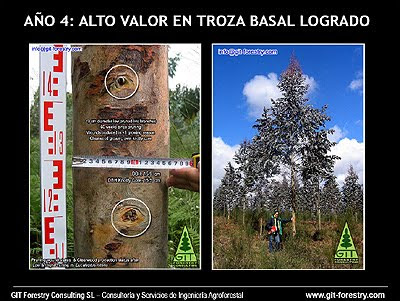
Fig. 2: 100 month old Eucalyptus nitens woody biomass before harvesting. You can see the trees in their whole size, and also a happy forester seeing they behave as expected in fast growth terms for this site! (Click image to enlarge)
So, which multi-purpose trees can have the best potential as woody biomass sources in humid Atlantic climates? Those more efficiently already converting light, water and nutrients into organic, renewable and predictable timber, from sea level to the snowlands. And certainly, very few other than plantation grown Eucalyptus can well match that description!
With a wide scale tree cultivation history spanning over 50 years, Northwestern & Northern Spain are some of the most productive timber hubs in Atlantic Europe, precisely thanks to Eucalyptus. In fact, Galician Eucalyptus timber harvest output currently means 1 out of each 4 logs harvested yearly in Spain.

Fig. 3: Tree Inventory detail showing Eucalyptus nitens fast growth potential (+20 cm DBH- Diameter at Breast Height, 100th month). (Click image to enlarge)
Over 10 different eucalypt species are grown as timber crops in the area, and the range of products sourced locally from these trees is as wide as high quality Eucalyptus solidwood for carpentry and furniture making, raw material for board and panel manufacture, or excellent raw timber for cellulosic pulp and paper production.
Eucalyptus timber use as biomass for energy is something not that new wherever these trees are cultivated. Each of the industrial lines mentioned do already use eucalypt wood as carbon neutral fuel. In fact, all timber based industries do convert part of the incoming raw timber into fuel, be it as non useful for sawmilling pieces of logs, be it as non suitable for board or panel fractions going to the co-generation boiler, be it as suboptimal for pulping fractions chipped and fed to the stove. In addition, some of them also use organic residues from the industrial process, rich in those chemical compounds of wood non useful for pulp, as biofuel. So, in varied forms, wherever an eucalypt based timber industry exists, Eucalyptus biomass is already used as biofuel. A renewable one.

Fig. 4: Sliced Eucalyptus nitens firewood log piece at DBH in its 100th month. Forester boot as size reference. (Click image to enlarge)
So, do Eucalyptus bio-energy crops already exist? Surely, in many places. In as many ways as silvicultural management regimes are applied to these planted tree crops. The diversity of possibilities is large. And the implications of each management regime producing biomass for energy are also diverse.
Purely 100% biomass for energy Eucalyptus timber crops are possible. Different designs for planting and plantation tending are possible. Combined pulpwood plus biomass for energy Eucalyptus timber crops are also possible. In fact, those are the most common variant of Eucalyptus cultivation in planted forests around the world. Combined multi-product planted forests yielding Eucalyptus biomass for bioenergy, plus logs for pulpwood or chipwood for pulping or board industries, plus high value logs for solidwood or veneer lines are also possible!

Fig. 5: Chart for Eucalyptus nitens dry biomass fraction weight and output estimation, developed by our good friend César Pérez Cruzado & collaborators (UXFS-USC) after much tree sampling and much wood laboratory work.
All of them are possible, and they all have their basement on two basic concepts. The first one is simple and well visible in the photo-thread of this article: the trees can grow very fast, shortening production cycles and ROI periods whatever the industrial line the main product of the planted Eucalyptus forest aims to.
The second concept is as old as forestry and the refining of silviculture of planted Eucalyptus forests: you can manage the stocking of your trees along their cultivation cycle in order to be able to extract timber from your tree stand along time, and at once letting the remaining trees achieve whichever desired log size and properties you may want. And, the good part, using the right tools developed by foresters, you can estimate and predict which are the amounts of raw timber, or its equivalent as any product (be it volumes of woodchips, pulp or board; be it dry weight of biomass in each of its fractions; be it power output of each of those fractions per tree or per hectare depending on when they are harvested... whatever necessary!!).

Fig. 6: Eucalyptus nitens Stand Density Management Diagram (SDMD) for Galicia (NW Spain). A very handy tool to estimate overall timber volume in a given plantation for a whole range of tree stocking after basic tree measuring. Also developed by Pérez Cruzado, Rodríguez Soalleiro & collaborators (UXFS-USC).
So, if you put in the same mix a given suitable timber tree, relatively well transferred experience in its cultivation for a given area, a wide array of visible different and diverse ways to grow the trees for different products but always with biomass and bioenergy as part of the equation, good forestry science based knowledge of the potential yield of these trees both from the point of view of productivity per surface unit regardless of how they are grown, and good forestry science based knowledge of the yield of the trees as producers of different fractions of biomass for energy... and you add to that some logistics for delivered cost of supply... and some biomass boiler parameters...
Exactly: you can predict bioenergy outputs from this type of woody biomass for a whole region... and their cost depending where the boilers are! Neat, eh? Galicia rocks!
Also at Eucalyptologics...



Want to contact us?

Contact GIT Forestry Consulting - Eucalyptologics

GIT's Eucalyptology Topics
© 2007-2010 Gustavo Iglesias Trabado. Please contact us if you want to use all or part of this text and photography elsewhere. We like to share, but we do not like rudeness.