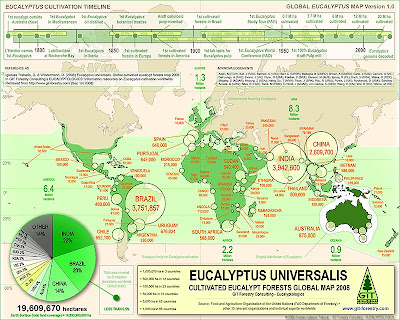
For over five decades now similar trends for planted forest establishment and management in temperate Atlantic climates have developed in several areas of the world after Max Jacobs & the pioneers of that time sparked the Global Eucalyptus Development Era. New technologies and know how developments in forestry tend to work like that. One or several "tree hubs" start pioneering one or several processes, starting by tree species trialling and refining the silvicultural practice, and later by working out or refining the different timber based industrial processes. And as forestry R+D spreads both within the public & private sectors in each of these "tree hubs", the different pieces of the know how puzzle can bee identified and put together, at the same time large scale operational timber plantations spread.
For the particular case of temperate eucalypt cultivation, these processes have meant the creation of bonds between foresters of distant places, between forestry research teams around the world, and between different nations, normally with many things in common, besides the same trees.
As an example of this, Galicia, the timber reserve of Spain, producing +50% of its yearly roundwood output, the rainy and green Northwestern Corner of Iberia, has many things in common with some other areas of the world where these particular eucalypts have become a sizable planted forest timber resource. One of those other areas is Southeastern Australia, particularly Tasmania and its virgin forests and planted forests. The area of the world where several of the key eucalypt species cultivated in Atlantic temperate climates do originate. Reason enough to inspire forestry discovery trips joining both sides of the world. From Tasmania, to "Tasmania del Norte".
And now, thanks to the kindness of Dr. Muñoz, and the digital magic of Aula de Silvicultura, you can also access and download a slideshow depicting the state of the art and new trends for Eucalyptus nitens planted forest silviculture in Chile, including very interesting angles, as the necessary operations to achieve an efficient utilization of this eucalypt timber for solidwood uses, and experiences carried on to make the species become, besides an excellent material for the pulp & paper industry, a very promising source of organic, renewable woody biomass when cultivated as energy crops. In addition, further lines of R+D on eucalypt cultivation and industrial processing were outlined: after Eucalyptus globulus & E. nitens, Chile aims now to develop market niches for planted forest products based on specialty timber crops: the new days of Eucalyptus regnans & E. camaldulensis are waiting ahead.
25% cheaper to build than other housing options based on energy costly materials. Turnkey delivery from scratch in just 45 days using a building team of 4 master carpenters. Saving energy for heating by winter and cooling by summer. Built using natural, organic, recyclable, durable and environmentally friendly wooden materials. Locally grown. Locally processed. Storing CO2 in long lifetime products. Avoiding the deforestation of native forests for valuable and scarce hardwood harvest. Welcome to the new Argentinian hi-tech Eucalyptus timber bio-housing world... in video!
(Click play to watch the video)
Governor Urribarri inaugurated the CEDEFI during his visit. The new research and education center for forest industry and timber products provides Entre Ríos, the fertile timber reserve of the Mesopotamia Argentina, bearing over 100,000 hectares of tree crops, over 1,500 industrial timber productive units (forest farms) and sustaining over 30,000 jobs in strategic primary production based industrial sector, with the best tool to train new workers in order to upscale the manufacture of pioneer wood products.
"The new Center for Industrial Forestry Development is an example of cooperation among 12 organizations, the National Government of the Argentinian Republic, the Government of Entre Ríos Province and a large number of civil associations. It allows this beautiful reality of men and women starting to dream on adding value to the primary production of our country"
"For decades we have seen thousands of young people departing Entre Ríos to find a job at industries and factories that were adding value to our primary products in other areas. Today we are starting to change the profile of our province, we are increasing our sustainable industrial activity, we are adding value to the fruits of our land and we are generating resources for our future"
Sergio Urribarri
Grandis, High Value Eucalyptus from the Argentinian Mesopotamia
Plantation grown Eucalyptus grandis solidwood sourced from Entre Ríos Province in the Mesopotamia of Argentina. The new gold of Argentinian forestry, growing in Entre Ríos, Corrientes and Misiones, a wonderful eucalypt timber, like Euroglobulus, very suitable for a million possibilities of high value uses.
Today we will keep walking along the timber ecosystem to show you how plantation grown E. globulus logs become sawntimber, and how those solidwood products keep generating added value and jobs, besides uniqueorganic, renewable, recyclable and environmentally friendly shapes, colours and textures: we will start exploring the nobility of Galician eucalypts.
Fig. 1: IFA President Dr. Peter Volker standing on plantation grown Tasmanian Blue Gum (Eucalyptus globulus) lumber grade logs at HVS Sawmill Woodyard (Galicia, Spain). The Tasmanian Floral Emblem has been milled for high value solidwood uses in Northern Spain for over 70 years. (Click image to enlarge)
It all starts with a wood log. That wonderful piece of a tree efficiently and naturally built from light, water and carbon recycled from soil and air. For the case of Northern Spain, such logs are sourced today from productive tree plantations established along the developing coastal Eucalyptus rainforest of Galicia during the 20th century. Wooden fruits of the tireless work of dozens of thousands of tree growers, landowners and silviculturalists, carried on voluntarily at their previously nearly treeless properties.
It would take some time until a new hardwood arrived, von Mueller's Prince of Eucalypts and a bit more until its cultivation for industrial timber supply purposes became noticeable. But, again, Galician sawmillers and timberjacks adopted it and adapted to it, this time aided by machines. Galician Eucalyptus sawmills were born.
Fig. 3: Processing a plantation grown Galician Blue Gum log through HVS' bandsaw to obtain eucalypt wood slabs. After the initial cut the E. globulus slabs are reprocessed to obtain dimensional lumber. (Click image to enlarge)
Since then, plantation grown Eucalyptus trees have been a source of specialty lumber logs for conoisseurs. Their special timber properties, result of fast growing rates and competition for light, different to the same timber in its native forests, had to be learned an dealt with by experience in order to yield usable sawnwood with reasonable recovery rates.
Each log becomes a different world. Each wood cut a challenge. But it was done. Galician sawmillers and master carpenters, devoid of other easy locally sourced hardwood timber choices, succeeded where the Californian feverish Eucalyptus timber industry of the second Gold Rush era failed.
Fig. 4: Eucalyptus globulus reprocessed slabs become dimensional lumber after re-sawing and finishing ("recanteado"). Besides direct uses as structural wood for housing inland, part of this Eucalyptus dimensional lumber is used to build the frameworks of Galician "Bateas" (Mussel & Oyster Farms) in the ocean. (Click image to enlarge)
Timber knowledge passed from generation to generation of sawmillers, today's examples as Hijos de Vicente Suárez Blanco, join more than 50 years of experience based wisdom on Eucalyptus globulus sawmilling and handcraft carpentry. Thanks to them, and others like them, Master Shipbuilders as Manuel Sánchez Torrado keep building wooden structures at dockyards, for immediate use in acquaculture. Thanks to them, and others like them, further value adding happens in Galicia, as finished slabs are also transformed into fine timber products by other local industrial lines.
Fig. 5: Galician & Tasmanian sawmillers inspecting the finished product area of HVS sawmill, where plantation grown Eucalyptus globulus logs have been converted into high value sawn timber products for multiple uses. The organically grown and nearly handcrafted noble wood will keep generating added value after this step, for direct carpentry work and further industrial processing, to become many other Eucalyptus solidwood based products. (Click image to enlarge)
A whole economic ecosystem based on the most noble uses of timber has grown and flourished in the Northern coast of Iberia, at the same time the coastal Eucalyptus rainforest has developed.
Its flow of organic matter (wood fibres) runs up and down the industrial chains based on this timber, generating jobs at every stage for wood workers and their families. Generating wealth that is recirculated in rural economies and primary resource based economies along this man made timberbelt, the Nova Australia eucalypt planted forests.
Generating energy savings with each ton of standing timber, each ton of sawnwood and each ton of wood products you may or may not choose against other materials with mindbowling energy costs to be manufactured.
Fig. 6: The life cycle and CO2 storage lifetime of plantation grown Eucalyptus globulus timber used for building purposes ranks in the "well over 100 years" timespan in Galicia. Reclaimed and Fresh wood are used for fine grade building in both "old and new" styles, either as structural timber pieces or as unique visual treat. Fine carpentry expert examples, as Hijos de Vicente Suárez works, expand the possibilities for noble wood uses of Tasmanian Blue Gum timbers and the value adding process. (Click image to enlarge).
Same way as Eucalyptus virgin cellulosic fibres are recycled as paper is recycled creating a long term pool of stored CO2, and hence being an useful tool in the fight against climate change, Eucalyptus globulus solidwood products, for their longer lifetimes and continued recycling of uses once serving their primary prupose, are also a stored CO2 pool.
Each of these plantation grown eucalypt timber pieces contributes at once to slow down the harvest of native hardwood forests with high value for preservation in other areas of the world, which is a positive externality, and an example of positive environmental impact. Each solidwood piece contributes to more efficient energy saving processes for raw material production, as this wood is totally organic, and, as every type of wood, built by nature using solar energy, not by burning fossil fuels. Each Galician Blue Gum log and solidwood piece is a living proof of cultivated forests being capable of generating sustainable products and services, positive social impacts and positive environmental impacts. Remember that each time you may read eucalypt plantations are not sustainable, or that the "foreign trees" cannot bur harm your local ecosystems.
Acknowledgements
To Peter Volker (Forestry Tasmania), Glenn & Shawn Britton (Britton Timbers, Tasmania) and Tony Jaeger (McKay Timber, Tasmania) for stopping by in their discovery trip around the world after the Eucalyptus beyond Australia. To the Suárez siblings and their staff (Maderas Hijos de Vicente Suárez Blanco SL), Alfonso and his staff (Maderas Costiña SL) and Master Carpenter Manuel Sánchez and family (Astilleros Manuel Sanchez Torrado SL) for their hospitality and daily work at forest and sea. To Isabel Puentes (FEARMAGA - Galician Federation of Sawmillers and Timber Suppliers) and Juan Picos (Asociación Galega Monte - Industria) for their support and company during the Mussel Day. To the fishermen and seafood cultivators of Galicia, for making it possible. To the tree growers and silviculturalists of Galicia, for making it possible too. And, looking back to days past, let's not forget to thank Alfonso Ozores, Marquiss of Aranda and the House of Rubianes for thinking like a mussel. And let's not forget either to thank Rafael Areses, Forester and eucalypt planter extraordinaire, for thinking like a tree at the same time Navarro de Andrade did.
Click the link above and an interactive list of all topics will display on top. You can use it to navigate EUCALYPTOLOGICS exploring the alphabetically indexed titles or sorting topics by key words.
You can also navigate the Blog Archive by expanding the list of topics above (click on the black triangles), using the key word tags at the bottom of each topic and at the menu to the left or using the links that normally appear from one blog post to previous ones. Enjoy!
... ABOUT
Welcome to the blog space of GIT Forestry Consulting. Here you can find regular comments on a wide range of topics concerning practical knowledge onEucalyptus cultivation, be it at nursery stage, at your gardens or at wider scale forestry plantations in cold temperate climates. Our main objective is trying to help growers worldwide with their doubts or comments in a more interactive way. In addition to the material here you are also welcome to visit our main website or contact us.