Largest Eucalyptus forests in Iberia blown down once more?
From February 27th to 28th 2010 the 228 km/h strong wind and rainstorm Xynthia swept accross the Atlantic from Madeira Island en route to coastal Atlantic Europe, causing widespread damage in Portugal, Northern Spain and Western France.
Fig. 1: Animation of the pathway of Storm Xynthia from the recently catastrophically damaged Madeira Island to the Baltic Sea, depicting heavily affected areas, including some of the most productive cultivated timberlands in Europe. Base satellite image courtesy Meteogalicia.
Of explosive cyclogenesis origin, as Klaus, the unusual and very fast moving wind blast, with intensities roughly equivalent to a Category 4 Hurricane for localized peak winds, caused catastrophic damage to infrastructures in Galicia and the Northern coast in Spain, affecting once more the largest Eucalyptus timberland in Europe before travelling as a Northeasterlie to hit the Charente Maritime, the Vendee and Brittany in France, causing at least 55 fatalities.
Fig. 2: Maximum wind speed readings by weather stations in Galicia during Storm Xynthia (27 to 28 February 2010) reaching 196 km/h. You can compare with similar peaks caused by Storm Klaus (23 to 24th January 2009). Base Map courtesy Meteogalicia.
Prospective Catastrophic Damage Areas for Pine & Eucalypt Forests in Galicia (NW Spain)
Once more, cross-checking wind impact cartography with timber resource allocation maps allows to roughly define those areas where winds in excess of 135 km/h may have caused heavy to catastrophic damage to tree plantations, windmill farms and varied industrial, communications and urban infrastructures.
Fig. 3: Prospective catastrophic damage areas caused by Storm Xynthia to Eucalyptus plantations in Galicia (Northwestern Spain). Top wind speed (km/h) remarked for each area. You can compare with damage caused by Storm Klaus (23 to 24th January 2009). Base Maps courtesy EUITF - Universidad de Vigo.
Fig. 4: Prospective catastrophic damage areas caused by Storm Xynthia to Pinus plantations in Galicia (Northwestern Spain). Top wind speed (km/h) remarked for each area. You can compare with damage caused by Storm Klaus (23 to 24th January 2009) Base Maps courtesy EUITF - Universidad de Vigo.
Even if peak wind speed approached that of Klaus, the average wind gusts were milder for most of Galicia, and prospective damaged timber growing areas are more localized. In addition, the wind peaks hiting the worst affected area by Klaus last year were milder this time, reaching "only" 122 km/h, sparing the very productive heavily Eucalyptus afforested Northern coast from catastrophe.
Some days after Storm Klaus hit the Northern coast of Spain and landed in Southwestern France, disruptions of daily life slowly disappear. Road blocks removed, power is being restored and rebuilding of damage to buildings and urban infrastructure slowly progresses. But out there, beyond the main roads, a vast catastrophe remains.
Gone with the wind, some of the most productive forests in Europe. Impacts in the short and medium term to rural economies and industrial wood supply are yet to be seen. The time to clean up the mess has come. It cannot be delayed. But with it, the time to start forest rebuilding must also come. It cannot be forgotten.
Fig. 3: Heavy damage to Eucalyptus nitens plantations on boggy soil pockets in the plateaus of inland Galicia (NW Spain) after +50 mm rainfall plus +135 km/h winds brought by Storm Klaus. (Photo courtesy Juan Picos / Asociación Galega Monte-Industria / Wikisilva.Click image to enlarge)
Fig. 4: Uprooted and stem-broken Radiata Pines in the plateaus of inland Galicia after sustaining winds in the range of 100 to 135 km/h from Storm Klaus. (Click image to enlarge)
Les Landes, Aquitaine, France
Fig. 5: Uprooted Maritime Pines in Les Landes, the largest forest of its kind in Europe, after sustaining exceeding 175 km/h from Storm Klaus. (Photo courtesy of Reuters & 20 Minutes. Click image to enlarge)
Fig. 6: Near total destruction in Pinus pinaster stands to the west of Bordeaux (Les Landes, Aquitaine) is today the typical landscape feature. (Photo courtesy of Reuters & 20 Minutes. Click image to enlarge)
Fig. 7: +50% levelled Pine stands will require starting over from square one. Operations for wood salvage must start before it rots in the floor if some value is to be recovered. (Photo courtesy of SIPA & 20 Minutes. Click image to enlarge)
Fig. 8: Stormwood salvage operations have started in Aquitaine, but with estimated volumes around 50,000,000 m3, the task could be more challenging than by 1999. (Photo courtesy of Reuters & 20 Minutes. Click image to enlarge)
Haute-Garonne, Midi-Pyrénées, France
Fig. 9: Beyond the Maritime Pine forest of Les Landes, both in Aquitaine and the Midi-Pyrenées regions, an important amount of other cultivated forests used to stand in the Eastwards route of Storm Klaus. Among them, some of the finest poplar forests in France. (Photo courtesy of Eurosilvasur, Observatory of the forest-wood-paper resource of the Southern Atlantic Arc Regions).
Fig. 10:Nearly totaly levelled poplar plantations in the Haute-Garonne (Midi-Pyrénées, France) after 75 mm of rainfall in 3 days followed by +170 km/h winds brought by Storm Klaus. (Photo courtesy Howard Lloyd @ Eucalyptus Passion. Click image to enlarge)
Largest Eucalyptus and Pinus forests in Europe blown down?
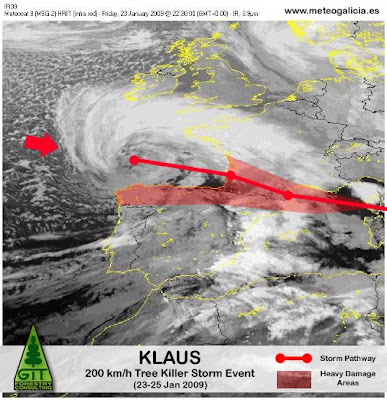
From January 23d to 25th 2009 the 200 km/h strong wind and rainstorm Klaus swept accross the Bay of Biscay en route to the Mediterranean Sea, causing widespread damage in Northern Spain and Southern France.
(See more images of wind damage to trees & infrastructures in Northwestern Spain)
Fig. 1: Pathway of Storm Klaus from the Bay of Biscay to the Mediterranean, depicting heavily affected areas, roughly corresponding with the most productive cultivated timberlands in Europe. Base satellite image courtesy Meteogalicia.
Maximum wind speeds set a new record for measurements in Galicia, surpassing the effects of cyclone Hortensia in 1984. Peak winds caused the worst impact in the Northern coast, where a big chunk of the largest cultivated Eucalyptus rainforest stands; and in the already heavily damaged higher highlands of Eastern Galicia, slowly recovering from previous damage to pine timberlands caused by the worst snow storm in 20 years, happening back in November and December 2008.
Fig. 2: Maximum wind speed readings by weather stations in Galicia during Storm Klaus (23 to 24th January). Base Map courtesy Meteogalicia.
Catastrophic Damage Areas for Pine & Eucalypt Forests in Galicia (NW Spain)
Cross-checking wind impact cartography with timber resource allocation maps allows to roughly define those areas where winds in excess of 135 km/h have caused heavy to catastrophic damage to tree plantations, windmill farms and varied industrial, communications and urban infrastructures.
Fig. 3: Catastrophic damage areas caused by Storm Klaus to Eucalyptus plantations in Galicia (Northwestern Spain). Top wind speed (km/h) remarked for each area. Base Maps courtesy EUITF - Universidad de Vigo.
Fig. 4: Catastrophic damage areas caused by Storm Klaus to Pinus plantations in Galicia (Northwestern Spain). Top wind speed (km/h) remarked for each area. Base Maps courtesy EUITF - Universidad de Vigo.
Largest Maritime Pine forest in Europe wiped out
After bashing the Northern coast of Spain, the Eye of Klaus impacted continental Europe in the French coast near Bordeaux, causing widespread damage to anything standing in its way to Marseilles. And in its way, the forest of Les Landes de Gascogne, the largest and most productive of its kind in Europe.
(See more images of wind damage to trees & infrastructures in Southern France)
French forestry officers have made a preliminary balance with grim perspectives, as roughly 60% of this impressive wood resource may have been heavily affected, including some 300,000 hectares of pine timberland receiving catastrophic wind damage.
UPDATE: Klaus Stormwood Inventory (Galicia, Spain)
Eucalyptus regeneration: tips & tricks for potted plants
Gustavo Iglesias Trabado GIT Forestry Consulting - Consultoría y Servicios de Ingeniería Agroforestal - www.git-forestry.com - EUCALYPTOLOGICS
We have previously seen in EUCALYPTOLOGICS a good number of examples of Eucalyptus regeneration at their natural habitats in Australia, timber plantations overseas and garden designs using these plants. Today we re-visit this topic from an angle that can be useful for those growers having overgrown potted eucalypts. A new outlook for those plants can be achieved taking advantage of Eucalyptus stubborness to survive.
Fig. 1: Initial stage of Eucalyptus regeneration by coppicing a potted specimen at nursery. New shoots emerge both from lignotuber and dormant axillary buds. (Click image to enlarge)
Fig. 2: Advanced stage of Eucalyptus regeneration by coppicing a potted specimen at nursery. (Click image to enlarge)
Fig. 3: Overgrown potted Eucalyptussuitable for recycling via coppicing. (Click image to enlarge)
Advantages of Recycling Potted Eucalyptus
A new outlook can be developed for specimens with poor form, signs of damage in their aerial part or having an aesthetic attractive below average
Can help assess comparative coppice vigour for different species, varieties or provenances, many of which are rare in cultivation
Forces the plant to produce new shoots of juvenile foliage, which can be interesting if this is the main ornamental feature
Keeps a door open to future annual or biannual severe pruning, starting over as the plants gain more size than desired in order to keep them as smaller potted specimens for display or as indoor plants
More suitable for fast growing Eucalyptusspecies, and better if juvenile leaf shapes are an important ornamental feature
Too old potted plants may be rootbound and might require root pruning and transplanting to bigger pots for this technique to yield best results
In most cases root quality is inferior in the long term compared to potted plants grown directly from seed to seedling and needing no coppicing, especially if these are grown using root air pruning techniques
Coppice timing must match appropriate seasonal conditions: plants need light, warm temperature and abundance of water and nutrients to rebuild... but pruning risks must be minimised
Coppice results are variable from specimen to specimen within the same plant lot, shape homogeneity is difficult to achieve sistematically without intensive observation and frequent interventions
Nutrient availability can be low or exhausted in an old potting mix, making a proper fertilisation/fertirrigation regime necessary
Click the link above and an interactive list of all topics will display on top. You can use it to navigate EUCALYPTOLOGICS exploring the alphabetically indexed titles or sorting topics by key words.
You can also navigate the Blog Archive by expanding the list of topics above (click on the black triangles), using the key word tags at the bottom of each topic and at the menu to the left or using the links that normally appear from one blog post to previous ones. Enjoy!
... ABOUT
Welcome to the blog space of GIT Forestry Consulting. Here you can find regular comments on a wide range of topics concerning practical knowledge onEucalyptus cultivation, be it at nursery stage, at your gardens or at wider scale forestry plantations in cold temperate climates. Our main objective is trying to help growers worldwide with their doubts or comments in a more interactive way. In addition to the material here you are also welcome to visit our main website or contact us.








 Contact GIT Forestry Consulting - Eucalyptologics
 GIT's Eucalyptology Topics