Share
Rooting Eucalyptus cuttings... by millions... everyday!

Fig. 1: Clonal gene bank. Multiple copies of several select genotypes are kept as pruned Mini-Hedges and used as mother plants. From these, cuttings are harvested regularly to multiply vegetatively the fastest growing high yielding strains of the hybrid Eucalyptus urophylla x grandis. When you manage an industrial forestry resource the way the Brazilian pulp and paper industry does, the motto is always "bigger, better, faster". And that starts from the very beginning! It means that each cultivated hectare should yield as much product as possible in as little time as possible at the lowest cost as possible without losing quality and under the principles of sustainable forestry.
Genetic improvement is a must for that. Tree breeding a need. It does not cost money, it saves money! After selecting the best performing specimens from wild or controlled crosses, what forest geneticists want is a whole estate filled with a new generation of supertrees. And the fastest way to deploy genetic gain is no other than mass propagation of select strains: Eucalyptus clonal forestry.

Fig. 2: Detail of the clonal Eucalyptus Mini-Hedge. Eucalyptus resurrection happens from dormant buds after each cutting harvest, providing new future cuttings, and hence new ramets. All in all, nothing different from what you do at home when propagating fig trees, bananas, agaves or a thousand other different plants whose fruits we use or whose looks we enjoy everyday. Except that for this process to be cost-effective in the case of Eucalyptus propagation, you need some extra ingredients...
First of all, you need something reasonable to propagate! You do not invest a truckload of money setting up the minimum infrastructure necessary for mass vegetative propagation without thinking first what trait you want to improve in your Eucalyptus trees. So, a lengthy process of testing and selection for the desired trait or traits must be done in advance. After that, you also need to consider that for cost-efficient mass propagation, you need genotypes with a high rooting ability for the rooting method you are going to apply. This means a more strict selection over candidate select strains, and ongoing tests to refine both selection and propagation methodologies!
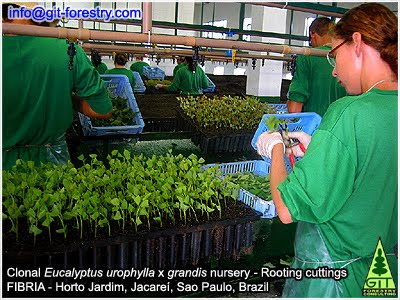
Fig. 3: Cutting selection and transplanting area. Select strains with high rooting ability harvested from the clonal bank are propagated by inducing root formation. Skilled labour and good control of temperature and humidity are necessary.
But having done all that, you yet need the proper minimum conditions to enhance root formation: high humidity, hygiene, nice temperature, a proper substrate, and a number of different environments to gradually move the rooted cuttings to their final destination.
Skilled labour is necessary at all stages: you need people with experience to harvest the Eucalyptus cuttings at the right time and with the right size; you need people with experience to select and prepare the Eucalyptus cuttings for rooting, and you need people with experience to prepare, handle and take care of the trays of Eucalyptus ramets along the whole production cycle.

Fig. 4: After a time at specially designed greenhouses, once roots have formed, the select Eucalyptus ramets are moved outdoors, to be grown to final planting size and to harden.
If all this is done properly, and if all the right ingredients are wisely used, then a Eucalyptus clonal nursery works as a Swiss clock, and is able to provide the right planting stock of supertrees as to replace an older generation of Eucalyptus timber crops by a faster growing higher yielding lower cost generation.
That is how you can increase the productivity of a given estate for the desired end product without necessarily increasing your cultivation area, which is a more costly alternative beyond a financial threshold. Which in turn can allow you to obtain faster growing renewable and recyclable fiber or biomass timber crops each year at once you manage your estate for simultaneous preservation of native ecosystems, hence avoiding some of the most evident environmental impacts of large monocultures.

Fig. 5: Only 7 years after planting, a whole new crop of Eucalyptus urograndis timber is ready for harvest, and as resurrection from coppice takes place without human intervention, a new cycle of timber production starts again almost by magic. (Click image to enlarge and see yours truly puzzled at growth rates).
In the end, growing trees, native or exotic, for an industrial purpose, if done joining at once the right technologies based on the study of tree biology and genetics and enough sensitivity to manage the man-made primary resource according to a minimum of consideration for the non productive pieces of the ecosystem... ends up relieving some pressure from other areas of the ecosystem. Always necessary while we try to keep up with the never-ending race to supply an always increasing world population with the basic raw materials that, we want it or not, will keep being demanded.
From these high tech cultivated Eucalyptus forests, the product (wood fibers) is transported to the nearby factory, where, under a thousand of different forms, it ends up becoming something you and I use everyday and some take for granted as a normal commodity.

Fig. 6: A sustainable timber production pattern that allows a proper feeding menu for the first single digestor in the world able to reach a production of 1,000,000 ton Eucalyptus cellulosic pulp (back in 2005!): FIBRIA's Jacareí Pulp & Paper Mill.
The work is not done however. It is being done every day. Since you started reading this article some minutes ago, some number between 10,000 and 15,000 eucalypts have been planted in Brazil alone to start producing the fibers you will use less than a decade ahead without even noticing. The same is happening all around the world as you read this: in Chile, Uruguay, South Africa, Spain, Portugal, India, China, Australia... And it all starts in a rooted Eucalyptus cutting.
Acknowledgements


Want to contact us?

Contact GIT Forestry Consulting - Eucalyptologics

GIT's Eucalyptology Topics
© 2007-2009 Gustavo Iglesias Trabado. Please contact us if you want to use all or part of this text and photography elsewhere. We like to share, but we do not like rudeness.
Click to Read Full Story...
Click to Display Summary only...
Share
Identifying Mystery Eucalyptus: The case of E. gunnii x nitens hybrids... in Denmark!
Today we bring you some more about eucalypt hybrids. In this case, a type with some interest for those growing the ubiquitous Australian trees in the boundaries of their tolerance to cold. From Denmark, after enduring 8 winters, and thanks to Martin Reimers, we take a peek at Eucalyptus gunnii x nitens ... in two botanical plates!

Fig. 1: Botanical assessment of photographic samples leading to the identification of Martin Reimers' mystery Eucalyptus growing in the Northern shores of the Flensburg Fjord, Denmark, as a hybrid Eucalyptus gunnii x nitens. (Click the image to enlarge, 1280 x 1024 pix)
Product of the viable cross of two relatively closely related eucalypt taxa (both E. gunnii and E. nitens belong to subgenus Symphyomyrtus, Section Maidenaria, and differ just as part of Series Orbiculares and Series Globulares respectively, so they are somewhat "close cousins") , this particular interserial hybrid combination would be very unlikely without human intervention, since each species has its habitat at one side of the Bass Strait. 
Fig. 2: Complementary botanical assessment of E. gunnii x nitens depicting the juvenile organs of both parent species and the hybrid cross. (Click image to enlarge, 1024 x 768 px).
Interestingly, Martin's tree shows some of the well desired effects of heterosis, and of a lucky combination of inherited good form, fast growth and cold hardiness. Precisely, if at some point we hinted that E. globulus x nitens could be of interest for some addition of cold hardiness to a benchmark species for short rotation timber plantations, this time the addition comes "on the other side of the frost spectrum".
Some Interesting Literature...
Listed below, some relevant bibliographic sources for cases like this, which could give the reader some insight on the mechanisms that made hybrid Eucalyptus trees like Martin's possible, and beyond possible, understandable. Reasons enough for compliments to be always sent to the Eucalyptus of France and Tasmania.
Cauvin B, Potts BM & Potts WC (1987). Eucalyptus: Hybridation artificielle - barrieres et hérédité des caracteres. Annales de Recherches Silvicoles 1986, AFOCEL, Paris. pp. 255-303.
Tibbits WN, & Reid JB (1987). Frost resistance in Eucalyptus nitens (Deane & Maiden) Maiden: genetic and seasonal aspects of variation. Australian Forest Research, 17 (1), 29-47 DOI: 0004-914X
Tibbits WN & Reid JB (1987). Frost Resistance in Eucalyptus nitens (Deane & Maiden) Maiden: Physiological Aspects of Hardiness. Australian Journal of Botany, 35 (3), 235-250. DOI: 10.1071/BT9870235
Griffin AR, Burgess IP & Wolf L (1988). Patterns of Natural and Manipulated Hybridisation in the Genus Eucalyptus L'Hérit. A Review. Australian Journal of Botany, 36 (1). DOI: 10.1071/BT9880041
Tibbits WN (1988). Germination and Morphology of Progeny From Controlled Pollinations of Eucalyptus nitens (Deane & Maiden) Maiden. Australian Journal of Botany, 36 (6). DOI: 10.1071/BT9880677
Tibbits WN (1989). Controlled Pollination Studies with Shining Gum (Eucalyptus nitens (Deane & Maiden) Maiden). Forestry, 62 (2), 111-126. DOI: 10.1093/forestry/62.2.111
Tibbits WN, Potts BM & Savva, MH (1991). Inheritance of freezing resistance in interspecific F1 hybrids of Eucalyptus. Theoretical and Applied Genetics, 83 (1). DOI: 10.1007/BF00229235
Bookmark this Interesting Link...

Besides a growing amount of information on the history of Eucalyptus cultivation in Denmark, at www.eukalyptus.dk you can find fine photographic examples of E. gunnii (Cider Gum), E. gunnii x nitens, E. perriniana (Spinning Gum), E. dalrympleana (Mountain White Gum), E. pauciflora ssp. debeuzevillei (Jounama Snow Gum), E. pauciflora (White Sallee), E. nitens (Shining Gum), E. urnigera (Urn Fruited Gum) E. rubida (Candlebark), E. barberi (Barber's Gum), E. coccifera (Tasmanian Snow Gum), E. johnstonii (Tasmanian Yellow Gum), E. subcrenulata (Alpine Yellow Gum) and E. delegatensis (Alpine Ash) including detailed records of their cultivation and behaviour in such an apparently impossible location as the fjords, plains and islands of Denmark.
Also in EUCALYPTOLOGICS... THE EUCALYPTUS OF THE FJORDS


Want to contact us?
Contact GIT Forestry Consulting - Eucalyptologics
GIT's Eucalyptology Topics
© 2007-2009 Gustavo Iglesias Trabado. Please contact us if you want to use all or part of this text and photography elsewhere. We like to share, but we do not like rudeness.
Click to Read Full Story...
Click to Display Summary only...
Share
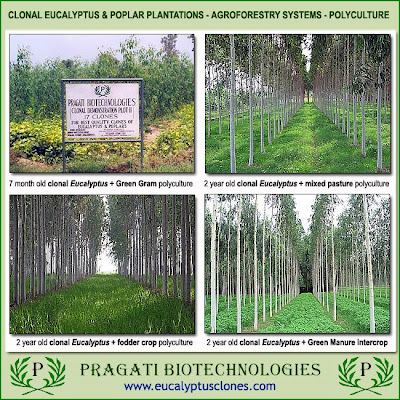
A combined plantation of Eucalyptus and wheat? Combining Eucalyptus and pasture? Planting at once Eucalyptus and green manure crops? Noooo. Are you nuts? That's impossible. Everyone knows the "Environmentalist Theorem nº 835/a" states that Eucalyptus are those evil alien invasive tree species poisonous to your soil, and where you plant one, nothing can grow again.
Luckily for our hungry world, reality is almost always very different to environmentalist mythology.
Eucalyptus Polyculture in India: timber and grain

But these versatile trees able to yield multiple products and services are not simply raised there for delivery to Indian farmers. Operational fields trials allow visitors to also see the combined outcomes of both tree breeding and intelligent agro-forestry design.
Eucalypt cultivated forests can achieve this way a new dimension: joining agricultural and forestry productions within the same pieces of land. Annual crops of yearly benefit while timber matures.
(Click image to enlarge)
Over 150 different select Eucalyptus clones, of both first generation pure and advanced generation E. tereticornis x camaldulensis hybrids, are being made available by Pragati Biotechnologies to tree investors in Punjab, Haryana & Uttar Pradesh wanting to take advantage of the genetic gains delivered by eucalypt tree domestication and breeding. Doubling or treebling the MAI achieved with standard tree nusery stock and making it compatible with other crops is no joke for a country with ever increasing needs of both food and raw timber. It is however a task for Norman Borlaug styled characters. Of Piare Lal type.
Corollary...
At Eucalyptologics we hope that, next time you hear or read one of the many misguided "environmental activist" trying to spread analphabetism on the subjects of monoculture, invasive alien species or Eucalyptus poisoning soils instead of trying helping fix the real problems out there, you remember cases as the one depicted today. You can then compare and decide for yourself what's going on with all that green mythology spreading like a noxious weed. Luckily, sooner or later, myths fall by their own weight. Or sometimes, with your extra help.
Also at EUCALYPTOLOGICS...
Contact us / Subscribe to Eucalyptologics
GIT's Eucalyptology Topics
© 2007-2008 Gustavo Iglesias Trabado. Please contact us if you want to use all or part of this text and photography elsewhere. We like to share, but we do not like rudeness.
Click to Read Full Story...
Click to Display Summary only...
Share
Swamp Bloodwood eucalypts: pink flowered tropical ornamentals
Notes on phenology and cultivation of Corymbia ptychocarpa (ex Eucalyptus ptychocarpa)
Gustavo Iglesias Trabado 
GIT Forestry Consulting - Consultoría y Servicios de Ingeniería Agroforestal - www.git-forestry.com - EUCALYPTOLOGICS
Fig. 1: Pink flower detail for Corymbia ptychocarpa at Harry P. Leu Gardens. (Image courtesy Eric Schmidt, click to enlarge) Swamp Bloodwoods have started blooming by October at Leu Gardens (Orlando, Florida), our friend Eric Schmidt, resident Botanical Records Specialist, reports. And this type of tree is exactly one of the nice possibilities for the ornamental use of red or pink flowering eucalypts in tropical or subtropical climates.
Fig. 2: Pink blooms in C. ptychocarpa ssp. ptychocarpa at Leu Gardens. (Image courtesy Eric Schmidt, click to enlarge)
With two main subspecies (ssp. ptychocarpa and ssp. aptycha), the natural habitat of this eucalypt is the Northern Coast of Australia, spanning scattered from QLD to WA. Temperatures here are mild day-long and year-long, frost is unheard of, and humidity levels are regularly high all over the year or at least there is a marked rainy season at some point.
Not surprisingly, this bloodwood eucalypt has become popular as a small tree in parks and gardens of the Northern Territory, where it is native and can bloom from February to June.
Fig. 3: Large broad adult leaves of C. ptychocarpa at Leu Gardens. (Image courtesy Eric Schmidt, click to enlarge)
So it is popular overseas. As Ester Foelkel reminds us, C. ptychocarpa is the main pink flowering eucalypt cultivated in alike climates of Brazil. And as we see at Leu Gardens, it can also thrive and bloom in the mildest areas of Florida even in its early years.

It could probably acclimatize well also in not so subtropical climates, with a mediterranean or mild temperate tendence even, as long as absolute minimum temperatures never go below -3ºC (25ºF, equating to USDA Zone 10 or the mildest part of Zone 9) and water supply is abundant, but not excessive. Unlike its close relative species C. ficifolia, it should not be too comfortable in arid conditions. Proper microclimates would increase the chance of survival, and sunny and sheltered spots would increase the chances of early blooming.
Also in EUCALYPTOLOGICS...
Contact us / Subscribe to Eucalyptologics
GIT's Eucalyptology Topics  Subscribe to receive EUCALYPTOLOGICS via RSS
© 2007-2008 Gustavo Iglesias Trabado. Please contact us if you want to use all or part of this text and photography elsewhere. We like to share, but we do not like rudeness.
Click to Read Full Story...
Click to Display Summary only...