Share
The Hen laying Golden Eggs in Galician Forests is... Australian
Galicia is a tiny sized autonomous region in Northwestern Spain, inhabited by some 2.8 million funny people who like to grow things. Some cultivate potatoes, other cultivate cabbage, and a few cultivate analphabetism. There are also over 600,000 hobbits who grow trees in the rainy green corner of Spain. In fact, the +1.4 million tree covered hectares of Galicia reach a 10% of total Spanish tree cover, and some 3% of total tree covered acreage in Europe. A tree country, we could say. 
Fig. 1: The size of record-breaking 2008 timber harvest in Galicia equals (if not exceeds) the highest building in the world if stacked over 1 hectare. (Click image to enlarge) But what does this mean? What makes Galicia special besides great seafood? Easy: that Galician 10% of Spain tree cover yields 50% of its total roundwood output. One of each 2 wood logs produced in Spain was grown and harvested in Galicia. And during 2008, a historic record was achieved. For the first time, the threshold of 8 million cubic meters of harvested roundwood was reached. If you stacked all that harvested wood during year 2008 over 1 hectare, you could build a pile at least as high as the Burj Dubai, the tallest building in the world. And... why all this blabla in an Eucalyptus blog? Because an important part of that yearly "Galician wood built Burj Dubai" would be made of harvested Eucalyptus timber! A recyclable and renewable primary resource of high quality for several industrial lines and of strategic importance for all.

Fig. 2: Galician timber harvests are 50% of total timber harvests in Spain. The overall harvested volume has increased a 40% compared to 1996. Statistics courtesy Juan Picos & Asociación Galega Monte-Industria. (Click image to enlarge)
During the last 30 years, Galician timber outputs increased three-fold while those in the other regions of Spain have remained nearly stable. That growing trend has been rocketing in the last 12 years, with a 40% increase in harvested volumes comparing 2008 to 1996.
Softwoods are one of the two engines of Galician forestry sector. The combined output of Radiata Pine, Maritime Pine, Scots Pine and Douglas Fir accounted a 56% of timber harvests back in 1996. By 2008 they remained at nearly 50% of annual harvested volume. The other engine is a special type of hardwood that grows mostly in Galicia's man-made coastal rainforests: Eucalyptus globulus, known among its growers as "Eucalipto do país".

Fig. 3: Eucalyptus timber harvests have yielded 1651 Million € to Galician timber growers during the last cultivation cycle. Statistics courtesy Juan Picos & Asociación Galega Monte-Industria. (Click image to enlarge)
The Eucalyptus tree belt of Galicia, covering less than 1% of the acreage of Spain, yields 25% of its annual timber output. Nothing similar can be said of any other tree, native or exotic, grown in these latitudes.
During the last cultivation cycle, Eucalyptus cultivated forests have generated 1651 Million € for Galician tree growers. That means, Eucalyptus timber crops alone, without considering for a moment the value-adding industrial chain using this timber as primary resource, have returned a 110% the amount of public subsidies for the whole of the agricultural, dairy and forestry sectors mustered by combined Galician, Spanish and European Union governmental authorities under the label of "Rural Development Programme 2007-2013".
In the last 12 years, the pouring analphabetism driven by a few misguided individuals has found its echo in different social strata. Within this time frame Eucalyptoculture has been excluded from public subsidised policy lines for forestry or rural development. And its not formally included in any public support programme up to at least 2013. Very smart line of thinking when there are good hints suggesting that the productivity of Eucalyptus cultivated forests in Galicia could yet increase a 60% by improving silviculture without the need of increasing acreage.
So, the one of the main question that could stay on the air after reviewing these macroeconomic numbers would possibly be no other than... are some Galician temporarily blind or permanently stupid?
Also in Eucalyptologics...


Want to contact us?
 Contact GIT Forestry Consulting - Eucalyptologics
 GIT's Eucalyptology Topics
 Subscribe to receive EUCALYPTOLOGICS via RSS
Click to Read Full Story...
Click to Display Summary only...
Share
Gone with the Wind
Some days after Storm Klaus hit the Northern coast of Spain and landed in Southwestern France, disruptions of daily life slowly disappear. Road blocks removed, power is being restored and rebuilding of damage to buildings and urban infrastructure slowly progresses. But out there, beyond the main roads, a vast catastrophe remains. Gone with the wind, some of the most productive forests in Europe. Impacts in the short and medium term to rural economies and industrial wood supply are yet to be seen. The time to clean up the mess has come. It cannot be delayed. But with it, the time to start forest rebuilding must also come. It cannot be forgotten.
Galicia, Northwestern Spain


Fig. 4: Uprooted and stem-broken Radiata Pines in the plateaus of inland Galicia after sustaining winds in the range of 100 to 135 km/h from Storm Klaus. (Click image to enlarge)
Les Landes, Aquitaine, France

Fig. 5: Uprooted Maritime Pines in Les Landes, the largest forest of its kind in Europe, after sustaining exceeding 175 km/h from Storm Klaus. (Photo courtesy of Reuters & 20 Minutes. Click image to enlarge)

Fig. 6: Near total destruction in Pinus pinaster stands to the west of Bordeaux (Les Landes, Aquitaine) is today the typical landscape feature. (Photo courtesy of Reuters & 20 Minutes. Click image to enlarge)

Fig. 7: +50% levelled Pine stands will require starting over from square one. Operations for wood salvage must start before it rots in the floor if some value is to be recovered. (Photo courtesy of SIPA & 20 Minutes. Click image to enlarge)

Fig. 8: Stormwood salvage operations have started in Aquitaine, but with estimated volumes around 50,000,000 m3, the task could be more challenging than by 1999. (Photo courtesy of Reuters & 20 Minutes. Click image to enlarge)
Haute-Garonne, Midi-Pyrénées, France

Fig. 9: Beyond the Maritime Pine forest of Les Landes, both in Aquitaine and the Midi-Pyrenées regions, an important amount of other cultivated forests used to stand in the Eastwards route of Storm Klaus. Among them, some of the finest poplar forests in France. (Photo courtesy of Eurosilvasur, Observatory of the forest-wood-paper resource of the Southern Atlantic Arc Regions).

Fig. 10: Nearly totaly levelled poplar plantations in the Haute-Garonne (Midi-Pyrénées, France) after 75 mm of rainfall in 3 days followed by +170 km/h winds brought by Storm Klaus. (Photo courtesy Howard Lloyd @ Eucalyptus Passion. Click image to enlarge)
Also in Eucalyptologics...
UPDATE: Storm Xynthia hits Galician forests... again!


Contact / subscribe to Eucalyptologics
Contact GIT Forestry Consulting - Eucalyptologics
GIT's Eucalyptology Topics
© 2007-2010 Gustavo Iglesias Trabado. Please contact us if you want to use all or part of this text and photography elsewhere. We like to share, but we do not like rudeness.
Click to Read Full Story...
Click to Display Summary only...
Share
Largest Eucalyptus and Pinus forests in Europe blown down?
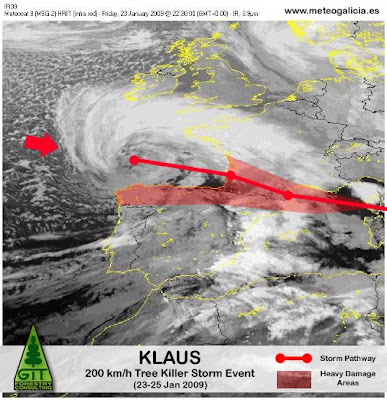
From January 23d to 25th 2009 the 200 km/h strong wind and rainstorm Klaus swept accross the Bay of Biscay en route to the Mediterranean Sea, causing widespread damage in Northern Spain and Southern France. 
(See more images of wind damage to trees & infrastructures in Northwestern Spain) Fig. 1: Pathway of Storm Klaus from the Bay of Biscay to the Mediterranean, depicting heavily affected areas, roughly corresponding with the most productive cultivated timberlands in Europe. Base satellite image courtesy Meteogalicia.
Maximum wind speeds set a new record for measurements in Galicia, surpassing the effects of cyclone Hortensia in 1984. Peak winds caused the worst impact in the Northern coast, where a big chunk of the largest cultivated Eucalyptus rainforest stands; and in the already heavily damaged higher highlands of Eastern Galicia, slowly recovering from previous damage to pine timberlands caused by the worst snow storm in 20 years, happening back in November and December 2008.

Fig. 2: Maximum wind speed readings by weather stations in Galicia during Storm Klaus (23 to 24th January). Base Map courtesy Meteogalicia.
Catastrophic Damage Areas for Pine & Eucalypt Forests in Galicia (NW Spain)
Cross-checking wind impact cartography with timber resource allocation maps allows to roughly define those areas where winds in excess of 135 km/h have caused heavy to catastrophic damage to tree plantations, windmill farms and varied industrial, communications and urban infrastructures.


Largest Maritime Pine forest in Europe wiped out
After bashing the Northern coast of Spain, the Eye of Klaus impacted continental Europe in the French coast near Bordeaux, causing widespread damage to anything standing in its way to Marseilles. And in its way, the forest of Les Landes de Gascogne, the largest and most productive of its kind in Europe.

(See more images of wind damage to trees & infrastructures in Southern France)
French forestry officers have made a preliminary balance with grim perspectives, as roughly 60% of this impressive wood resource may have been heavily affected, including some 300,000 hectares of pine timberland receiving catastrophic wind damage.
Click to Read Full Story...
Click to Display Summary only...
Share
TREE CLIMBERS MEASURE THE TALLEST TREES IN AFRICA
by Izak van der Merwe (1)
On November 2008 a pair of professional tree climbers scaled the two tallest trees in Africa, also considered to be the tallest planted Eucalyptus trees in the world. Recently dubbed the “Twin Giants of Magoebaskloof”, these Saligna gum trees form part of a magnificent stand of tall trees on the Woodbush State Forest near Haenertsburg planted in 1906. Benefiting from a wet sub-tropical climate and deep soils, they grew to a height not surpassed anywhere in Africa. The tallest tree in this stand was measured by a land surveyor six years ago at a height of 81.5 metres (+265 feet), but the tree toppled over during a storm in September 2006. 
Fig. 1 - Giant Tree Climbing Expedition members at Benvie Arboretum (New Hanover, South Africa) besides the tallest Eucalyptus regnans in Africa, and possibly the tallest cultivated E. regnans in the world. Photo courtesy Izak van der Merwe. (Click image to enlarge)
A panel of experts assisting the Department of Water Affairs and Forestry (DWAF) to identify and protect trees of national conservation significance as Champion Trees, recently shortlisted the giant eucalypts of Woodbush as a priority for protection. Other three giant eucalypts at Benvie Arboretum seven hundred kilometers from here were also shortlisted. These Mountain ash trees (Eucalyptus regnans) have magnificent trunk circumferences of more than 6.8 m (+22 feet), a trunk size not yet seen among any other trees of this kind in South Africa. They were planted more than a hundred years ago by the Scottish emigrant John Geekie, a cabinet maker by trade, who purchased Benvie Farm in 1882 and imported tree seedlings from around the world. Jenny Robinson, a great granddaughter of John, currently manages the arboretum and keeps the family tradition at Intigo Furniture.
The idea for an expedition to find and measure the tallest tree in Africa originated with Professor Brian Bredenkamp (now retired from the University of Stellenbosch but not from tree matters!). Roy Wilson, of the company Stihl - South Africa was approached for sponsorship, and immediately agreed to cover the travel and accommodation expenses for this expedition. They would be accompanied by the professional tree climbers Leon Visser and Charles Green as well as Izak van der Merwe, coordinator of the Champion Tree Project of the Department of Water Affairs and Forestry.

Fig.2 - Location of the Champion Eucalyptus of South Africa measured during the Giant Tree Climbing Expedition
On the morning of 7 November the expedition left OR Tambo airport for Magoebaskloof. At Woodbush State Forest the search for the potential tallest tree that afternoon ended at a giant eucalypt tree very close to the original champion, which now lies on the forest floor next to its broken stump. The long slender bowl of the tallest tree offered difficult climbing, especially in the prevailing wet weather. The tree climbers then decided to first scale a slightly shorter tree next to it. At 70 metres above the ground they threw ropes around the branches of the targeted tree and bridged the gap through a technique known as “skywalking”. The two trees were measured at 79 metres (259 feet) and 78.5 metres (257 feet) respectively, thus crowning the Twin Giants of Magoebaskloof as the tallest measured trees in Africa.

Fig. 3 - Giant Tree Climbing Expedition members at Woodbush State Forest Arboretum (South Africa) climbing one of the Twin Giants of Magoebasklook, the tallest known trees in Africa, and possibly the tallest cultivated Eucalyptus in the world. Photo courtesy Izak van der Merwe. (Click image to enlarge)
The forester of Woodbush State Forest, Mr Tiennie Nieuwoudt of Komatiland Forests, undertook to reroute the Magoebaskloof hiking trail slightly so that hikers and sightseers will gain access to these trees. DWAF, Komatiland Forests and Stihl - South Africa will work together on appropriate signage and information boards to be placed at these trees.
The Benvie Arboretum eucalypt trees were visited on 9 November, and the height of the tallest of these Eucalyptus regnans was measured at 61 metres by the tree climbers. Two of the three trees standing in line were severely damaged by lightning. The tree climbers discovered that a large part of its top had broken off and was lying on top of the crown, so the tree must have been considerably taller in its prime. Measures are being considered to brace the damaged top of this tree to prevent further damage.
Contacts
EUCALYPTOLOGICS thanks go to...


Also at EUCALYPTOLOGICS...


More Eucalyptus Giants around this site
Contact us / Subscribe to Eucalyptologics
Contact GIT Forestry Consulting - Eucalyptologics
GIT's Eucalyptology Topics Subscribe to receive EUCALYPTOLOGICS via RSS
Click to Read Full Story...
Click to Display Summary only...








 Subscribe to receive EUCALYPTOLOGICS via e-mail


