





![[Valid Atom 1.0]](https://lh3.googleusercontent.com/blogger_img_proxy/AEn0k_u7pzicizzwU5dwhJriSYxESg4EBRw5VjQo49ZHj3Uj0-pv2AZbVlgWlP8dw5zWukN0-Z9mAeEFT9byDeRZutdUU6G_9Q9LOSsdVBqGGaKYaPPPLRmc=s0-d "Validate my Atom 1.0 feed")


Ground Zero: Northern coastal Eucalyptus forests
Gustavo Iglesias Trabado
GIT Forestry Consulting - Consultoría y Servicios de Ingeniería Agroforestal- www.git-forestry.com - EUCALYPTOLOGICS
GIT Forestry Consulting - Consultoría y Servicios de Ingeniería Agroforestal- www.git-forestry.com - EUCALYPTOLOGICS
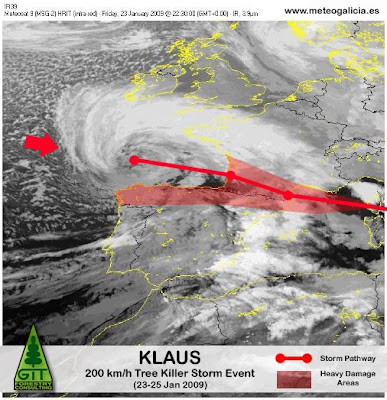
Explosive extratropical cyclone Klaus wiped out the Northern coast of Spain en route to South Western France by the end of January 2009, causing the worst damage to the forests of Galicia in 25 years, including severe effects on some of the most productive timberlands in Europe.
A first inventory coordinated by Galician forestry authorities during February yielded a first official approach to stormwood volumes and their geographical distribution. We bring you today a visual summary of that inventory, depicting localised and scattered stormwood areas, main timber species, geographically related stormwood volumes and the location of the most obvious export facilities.

Fig. 1: Spatial distribution of stormwood volumes after damage caused by windstorm Klaus to forestry resources in Galicia (NW Spain). (Click image to get a full size version, free of charge, by request)
Total stormwood volumes in Galicia after Event Klaus are estimated in the range of 1.2 to 1.8 million cubic metres, roughly 55% Pines (mainly P. radiata) and 40% Eucalyptus (mainly E. globulus).
Klaus' Stormwood in Galicia: Key Points
- Roughly one third of total stormwood volume is relatively localised around the coastal town of Viveiro, in Northern Lugo province, which becomes "Ground Zero". Even here, damage is scattered at basin level, and also within management units.
- Scattered damage means timber extraction has become a slow and dangerous process involving considerably higher costs than usual per salvaged ton, making the less accessible areas difficult to tidy up without incurring on operational losses.
- Galician authorities have asigned a relief fund for an amount of 7 million € to help cover these extraordinary harvest and haulage costs and to establish temporary wood yards able to stockpile stormwood for a gradual supply to wood industries.
- Total stormwood volumes are lower than the total combined regional forestry industry processing capacity, however current wood products market situation (global crisis) implies low sales for certain processing chains, impacting wood demand negatively and forcing a slowly gradual use of this unexpected wood supply by industry.
- Opportunities for timber exports may arise, especially for sensible sized woodlots easily stored near or at export facilities. One third of total stormwood volume is high quality E. globulus pulpwood logs fallen close to several local ports.
Also in Eucalyptologics...

The fallen forests: Legacy of Storm Klaus over Eucalyptus, Pines and Poplars of South-Western Europe
UPDATE: Storm Xynthia hits Galician forests... again!


Contact / subscribe to Eucalyptologics
 Contact GIT Forestry Consulting - Eucalyptologics
 GIT's Eucalyptology Topics
© 2007-2009 Gustavo Iglesias Trabado. Please contact us if you want to use all or part of this text and photography elsewhere. We like to share, but we do not like rudeness.


