


![[Valid Atom 1.0]](https://lh3.googleusercontent.com/blogger_img_proxy/AEn0k_vo6KkSjKiayE2NdFwBhCGt78DnXEi0-lhMi0vzaB0xsVYBkgmnbSmSMy4Vf7K4HLuwucw0O1MNg30vqX5DaM_DQAZ4e3pdRcTs0R17BCiZNVRMeI6F=s0-d "Validate my Atom 1.0 feed")


Eucalyptus: Sowing Small Miracles

"Closer contact with the city of Addis Ababa showed that its attractiveness seen from afar was an illusion. The houses are built of mud over a framework of Eucalyptus poles tied together with homemade grass ropes and most of them are whitewashed. There are no sidewalks and the roads are roughly paved with sharp rocks laid by hand. As there are no street lights, foreigners stumble badly when trying to get around at night although the barefooted natives do not seem to have any difficulty. The surrounding hills and the innumerable Eucalyptus trees, however, are beautiful. This was a treeless country until the government imported literally millions of Eucalyptus sprouts from Australia."
U.S. Navy radio operators reporting from Abyssinia in 1935 under Cornelius Van Hemert Engert, US Minister Resident
"Ethiopia hosted about 201,700 refugees and asylum seekers (…) 111,600 Somalis who fled the collapse of the Somali state (…) 55,400 Sudanese who fled the civil war in the south of Sudan (…) some 23,900 Eritrean refugees (…) New Eritrean arrivals received four eucalyptus poles and a plastic sheet for shelter"
United States Committee for Refugees and Immigrants - World Refugee Survey 2008
"About 450 000 Rwandan refugees have flooded into ex-Zaire over the border of South Kivu (…) A large part of fuelwood was also supplied by the National Research Centre for Natural Sciences (CRSN), which is located about 20 km north of the camp. The staff of CRSN cut down Eucalyptus trees on its site and sold them to obtain cash for everyday living. (…) The camp site was almost cropless when we visited it. (…) The Eucalyptus owned by CRSN, which were cut down but left with stumps, are regenerating and are up to 10 to 15 cm in diameter and several meters high"
Hiroaki Sato et al, Japanese aid to Rwandan Refugees on Eastern D. R. Congo
"More than 165,000 people are living in the camps (…) An oasis garden, however, shaded by eucalyptus trees, grows some fruit and vegetables …"
Australian Delegation to Saharawi Refugee Camps in Tindouf
"When Rwandan refugees arrived, many natural coppices were cut down. Today Mwese is on the steep range of hills with very few woods. At the same time of the refugee camp, new woods were brought about; blue gums (Eucalyptus globulus Labill. L.), Scotch pines (Pinus sylvestris L.), common spruces (Pinus abies L. Karst), and today these woods are commonly used as timbers."
Abe Yuko, Japanese aid in Tanzania

"A total of 130,000 refugees including two minority groups, the Karen and the Karenni, have fled from Myanmar to Thailand (…) Bamboo and eucalyptus are the main building materials. These are procured outside the camp and shipped in by SVA because cutting timber in the camp area is prohibited. The roofs are made from leaves that fall from trees within the camp. As there is no electricity in the camps, six semi-transparent plastic sheets about two meters in length are built into the roof as skylights to provide interior lighting. Floors are raised on stilts. Male refugees construct the building and it takes eight men about ten days to complete it."
Miyake Takafumi, Japanese aid in Thailand
"As many as 120,000 Lebanese refugees are stranded in Beirut after fleeing the conflict (…) With the first donations the students set up two drinking water tanks under a eucalyptus tree. Three to four hundred people currently live in the park …"
Ulrike Putz reporting from Beirut to Der Spiegel
"The amount of wood distributed to refugees in the camps increased by a factor of three (…) trucks brought some 650 tons of wood to the camps each day, approximately equivalent to cutting one square kilometer of eucalyptus stands per month (…) when that figure is applied to overall wood consumption rates in all five camps, we see that the wood-distribution efforts effectively allowed a significant reduction in the deforestation rate"
José Kalpers, WWF aid in Congo & Rwanda
"We learn that this particular Batwa community recently fled to the Ugandan side of the border after much of their clan was wiped out by Rwandan soldiers (…)They sit us on a crooked eucalyptus bench and proceed to sing and dance with great intensity. The cumulative effect of the entire experience leaves us teary-eyed and emotionally depleted. (…) The shell of Idi Amin's old villa haunts the landscape. As the sun sets, we watch evening commuters paddling home in eucalyptus canoes."
Lynn Nottage, US aid in Uganda & Congo
"Thai authorities also asked to supply materials for housing repairs in all camps since they were concerned that the refugees were still depleting the local forests. During that year bamboo and eucalyptus poles were supplied to most camps and thatch or roofing leaves to some (…) We committed to providing sufficient materials for building new houses and repairs so that refugees should not have to leave the camps to supplement the building materials supplied, thereby exposing themselves to the risk of arrest or abuse."
Thailand Burma Border Consortium, UK aid in Thailand
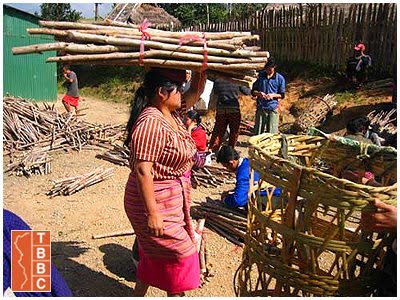
"The refugees were cutting down seventy tons of firewood a day... that's like five tractor-trailers of firewood each day! It was a big problem. So the Evangelical Church of the Congo asked us to help with a reforestation project. The idea was it was compensation for the local communities that had welcomed the refugees. The communities benefited from the reforestation, and we also hired people from those communities to work in the nurseries. We produced about a million trees. The project propagated and planted eucalyptus trees, since that was the variety that was cut down for firewood."
Krista Rigalo and Fidele Lumeya, Peace Missionaries in Congo
"They use pretty much anything they can lay their hands on, but that eucalyptus — because it grows so well there — is the main framing material that is used. Then layers of a mud preparation are applied directly to the framing — first on the inside and, following a cure time of three weeks, on the outside. An iron roof goes on top and that’s prettymuch it."
Marty van der Burg, NZ aid in Ethiopia (Ethiopia: Habitat for Humanity)
"Clean water was not readily available. The family cooked over a small fire of twigs and dried eucalyptus leaves. They had only one bottle, and no refrigerator. It was a recipe for disaster, but I thought maybe the child would get enough calories to recover."
Christina Zarowski, Canadian aid in Ethiopia
"Eucalipto nao se come" ("You cannot eat Eucalyptus") - Vía Campesina, justifiying destruction of Eucalyptus timber crops for no useful purpose

"Those trees came from Australia 30 years ago, when I was a boy. We have grown up together."
Ras Tafari Makonnen – Haile Selassie I of Ethiopia, 1935
Eucalyptus... Firewood... Shelter... Housing... Shade... Timber... Labour... Building... Protection... Hope
"The means may be likened to a seed, the end to a tree: and there is just the same inviolable connection between the means and the end as there is between the seed and the tree"
Mohandas Karamchand Gandhi (1869-1948)

Eucalyptologics joins the Bloggers Unite for Refugees effort with small miracle stories for those fighting in silence, through no violence, to make this world a better place. Sow your humble seeds and nurture them. In peace.